


Earlier this month, Zoom made a bold move by acquiring sales intelligence specialist Common Room.
The acquisition surprised many, myself included, even though I was aware of Zoom’s growing ambitions in sales and revenue technology.
Common Room was founded in 2020 as a community intelligence platform. It raised more than $50M across three funding rounds and has approximately 180 employees, suggesting annual recurring revenue around $20M.
The company captures buying and engagement signals across public and community ecosystems, including GitHub, Reddit, Discord, Slack communities, and, of course, LinkedIn. While it initially focused on helping companies uncover the “dark funnel,” Common Room evolved into a broader sales intelligence platform centered on a CDP-like data foundation. It unifies first-, second-, and third-party data into what it calls a customer journey graph, with capabilities including identity resolution, waterfall enrichment, and signal aggregation.
Common Room allows users to layer workflow logic or AI agents on top of its graph to score both individuals and companies, and orchestrate targeted sales plays. The resulting intelligence can be consumed through Common Room’s own seller interface, pushed into engagement platforms, or exposed to AI agents through MCP.
Zoom formally entered the SalesTech market in April 2022 with the launch of Zoom IQ for Sales, its conversation intelligence solution. I say “formally” because Zoom already had footholds in sales workflows through Zoom Meetings and Zoom Contact Center. In September 2023, the company rebranded Zoom IQ for Sales as Zoom Revenue Accelerator, later expanding it into an umbrella for its sales solution, adding capabilities such as deal intelligence, coaching, next-best actions, and automated CRM updates.
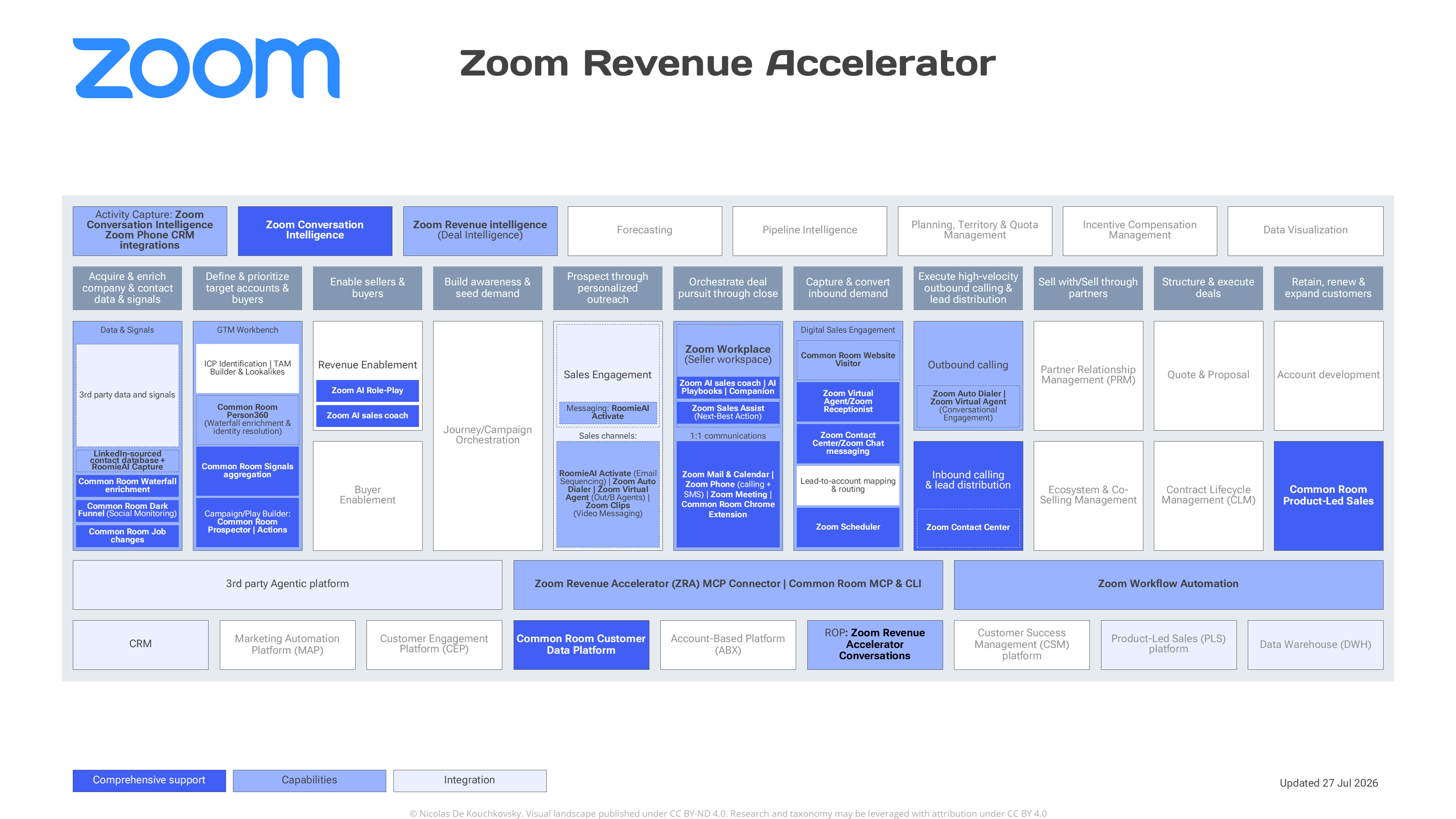
Zoom has architected its sales offering on top of a comprehensive communications platform. To understand the full breadth of its portfolio, you need to look beyond Zoom Revenue Accelerator and include platform capabilities such as Zoom Contact Center with its built-in auto dialer, Zoom Virtual Agent, and more.
Combined, the broader Zoom platform, Zoom Revenue Accelerator, and Common Room provide strong coverage across the revenue stack. Using my new Revenue Blueprint, I mapped the full breadth of the Zoom portfolio’s sales capabilities.
Zoom is now a company to watch in the SalesTech market, across both B2B and B2C. The Common Room acquisition adds a solid sales intelligence layer to its broader communications and revenue platform and propels it into the group of SalesTech consolidators.
Zoom has the ingredients to become a meaningful player in the evolving revenue technology landscape. Capturing this opportunity will require it to bring together its portfolio of capabilities, deepen its functionality across key SalesTech categories, and expand its go-to-market motion to engage a broader set of buyers beyond its traditional communications and IT audience.