


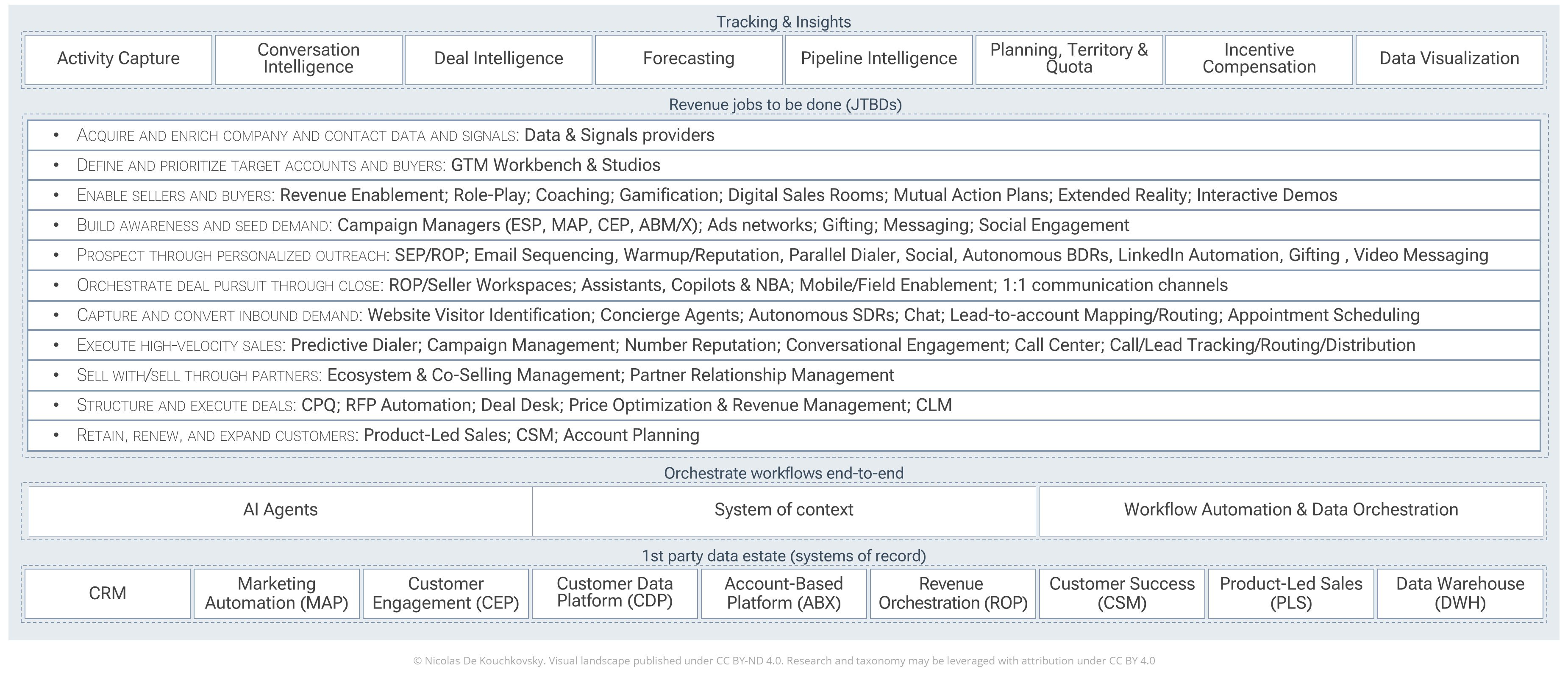
11 years ago, I created an Inside Sales Technology Landscape. While widely known as a map of categories and companies in the space, it was originally designed as a blueprint for architecting a software stack supporting inside sales.
The framework proved remarkably durable. I expanded it over the years to cover the full sales software landscape. It held up through a decade of innovation... up until agentic AI emerged.
The need for a reset became clear when I published its latest edition last November. So when Seth Marrs reached out to discuss assembling a blueprint to guide the design of a revenue stack, I seized the opportunity to leverage his insights to build it.
Data and AI now enable organizations to segment and target their market with laser precision, on a continuously updated basis:
Define ideal customer profiles (ICP)
Build a full, enriched total addressable market (TAM)
Map buyers and buying committees to expand each target account with the relevant contacts
Segment markets with far greater granularity
Identify and aggregate signals that indicate emerging demand or timing
Build scoring models combining fit, segment, and signals to prioritize accounts and contacts, and trigger the right sales and marketing plays
This data-driven market definition and prioritization foundation becomes the backbone of both sales and marketing, driving tighter alignment. It hinges on acquiring and enriching company, contact, and signal data, and combining it with your proprietary data.

AI is the catalyst for organizations to rethink their sales processes, shifting focus to end-to-end Jobs to Be Done (JTBD). We’ve become addicted to adding a new point solution for every sales engagement “play,” creating a patchwork of tools with poorly-connected mini-workflows. The result is constant context switching and friction at every handoff, ultimately impeding execution.
We can group the core JTBDs into the following:
Enable sellers and buyers
Build awareness & seed demand
Prospect through personalized outreach
Orchestrate deal pursuit through close
Capture & convert inbound demand
Execute high-velocity outbound calling & lead distribution
Sell with and through partners
Structure & execute deals
Retain, renew, and expand customers
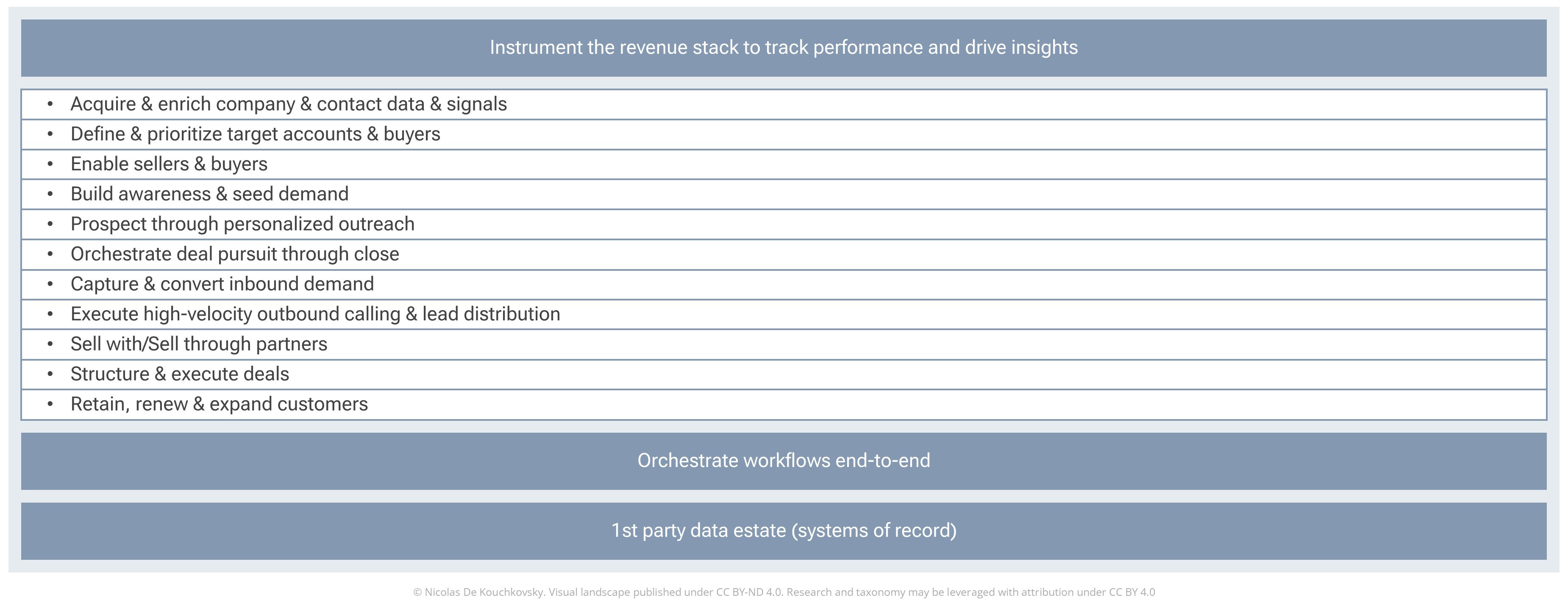
Not all of these apply to every organization, and relevance depends on your sales motions—inbound vs. outbound, targeted prospecting vs. high-velocity sales, partner-led models (sell-through vs. sell-with), account development, and product-led sales. These JTBDs can be mapped to the software categories that enable them.
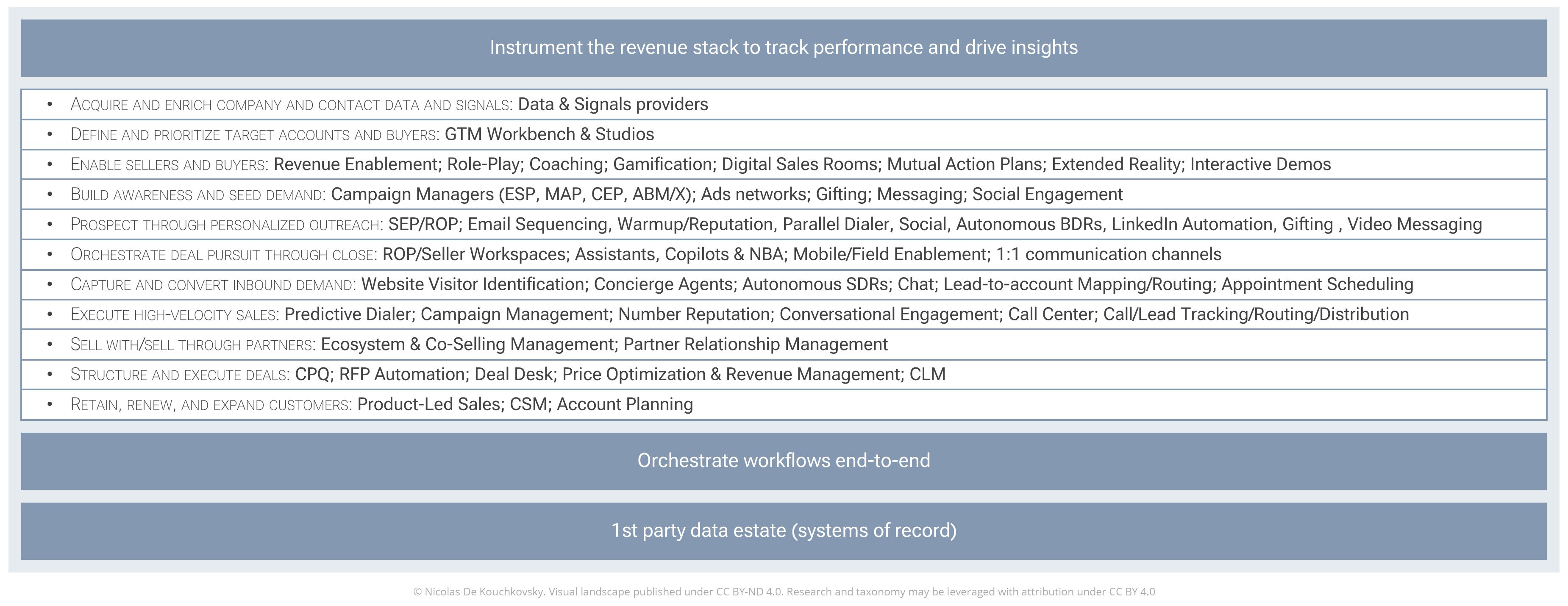
The fragmentation of sales stacks, combined with persistent disconnects between marketing and sales systems, has driven a shift: from application-level reporting and analytics to a cross-stack instrumentation layer that captures engagement and sales activity and delivers a single source of truth for forecasting, pipeline, and performance management.

Agentic AI is inserting itself into the stack as a foundational layer that can execute workflows and act on them. It relies on a system of context that aggregates all the information required to execute its missions. It sits alongside legacy workflow automation and data orchestration technologies.

In this construct, systems of record sit at the base of the stack as the systems of truth for core data elements, providing context for AI.

It’s impossible to provide full color and detail in a single post. In the coming weeks, I will continue to unpack this new framework and share examples of how you can use it to map existing providers and your as-is and to-be stacks.