


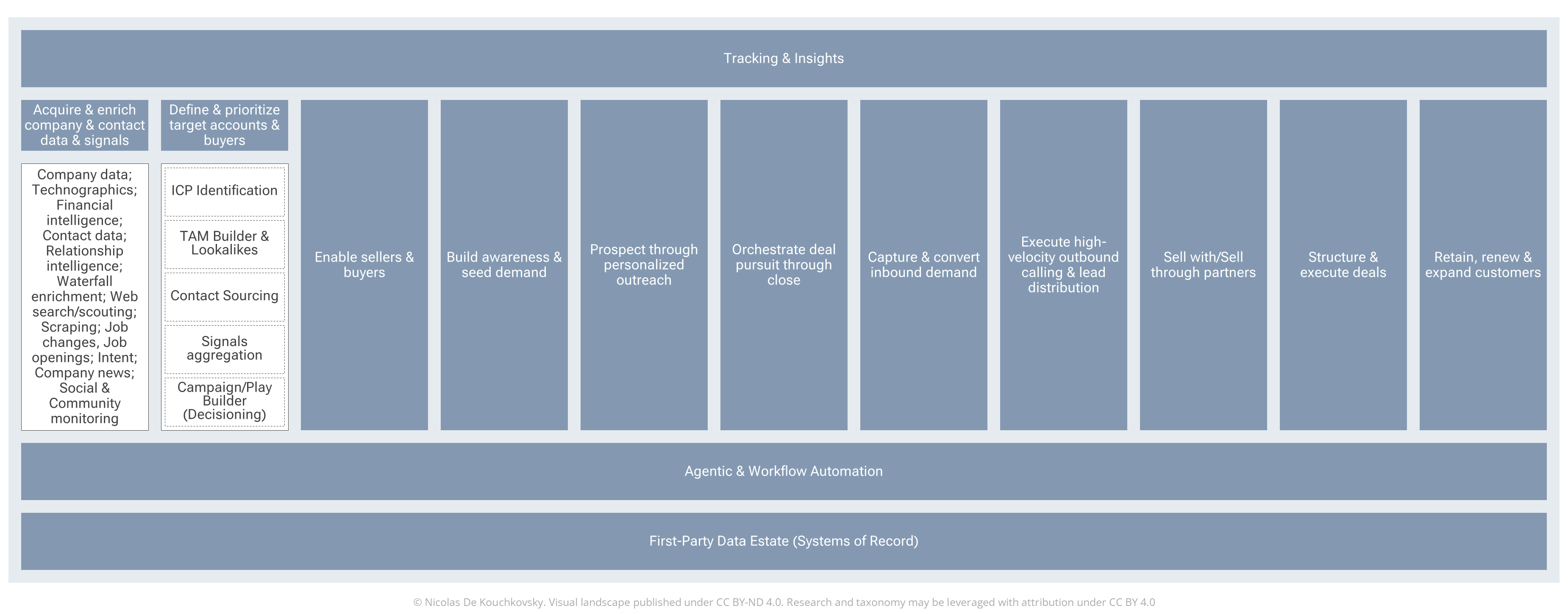
In this second installment, I continue unpacking my new Revenue Blueprint, double-clicking on two critical jobs-to-be-done:
Defining and prioritizing target accounts and buyers
Acquiring and enriching company and contact data and signals
The abundance of data and AI are transforming how companies define who they should sell to and when they should engage them.

It starts with defining and identifying your Ideal Customer Profile (ICP). AI can analyze your existing customer base to identify which customers are truly your best, looking beyond revenue contribution to dimensions such as lifetime value, including upsell and cross-sell potential, cost to serve, and other relevant factors. Rather than handpicking a few representative customers, you can analyze a much broader set of data points and then clean and enrich the attributes of these highest-value customers to uncover what makes them ideal. While parts of this process are still mostly done manually, specialized solutions such as AlignICP, HG Insights through its MadKudu acquisition, and Revic AI are emerging to support this process end-to-end.
From there, precise ICP definitions can be used to build a comprehensive account universe for your Total Addressable Market (TAM) or identify lookalike accounts. The next steps are to:
source contacts matching your target personas and covering the key members of the buying committee,
gather signals from both your own interactions and third-party sources across those accounts and contacts, and
layer on decisioning models to trigger sales and marketing actions.
Traditionally, this work was done across systems of record (f.e. CRM or Account-Based Platform) and sales intelligence platforms such as D&B and ZoomInfo. Clay has introduced a new approach that I characterize as a GTM Workbench, allowing you to aggregate and orchestrate data from multiple sources within a single environment. Many vendors now call these environments “studios.”
Signal-based selling has become a buzzword, and many vendors have poured every data point into the signals category. I have long advocated for a clear distinction between segmentation, which relies on static or slow-changing attributes, and signals, which are inherently dynamic. I also found signals are most valuable when aggregated and layered on top of your TAM, creating a dynamic view of which accounts and contacts warrant action. Vendors don’t often expose their underlying aggregation data platform, making this category difficult to track. Examples include Common Room (acquired by Zoom), Tapistro, and UserGems.
The final step is turning this data and signals into decisions about which accounts and contacts should be prioritized for enrollment in sales and marketing programs and campaigns. This can be done through AI-based scoring or workflow logic layered on top of data and signals, with the resulting decisions triggering campaigns and plays.
Taken together, these steps turn the job of defining and prioritizing target accounts and buyers into an end-to-end process spanning ICP definition, TAM construction, contact sourcing, signal aggregation, and activation.
It hinges on the ability to acquire and enrich company and contact data and signals.

Company and contact data providers typically offer a mix of company data (firmographics) and contact data (demographics). Specialists can also provide technology data (technographics), financial intelligence, and/or relationship intelligence.
Signal providers typically deliver some combination of company news, intent, job changes, job openings, and social and community monitoring.
Today, most providers draw on multiple sources to build their datasets. Understanding how that information is sourced, whether through in-house research and validation, purchased datasets, or the open internet using web search and other forms of scouting, is crucial. So is understanding whether providers maintain comprehensive coverage of specific segments, by industry, country, business size, or function, or are simply aggregating the data available to them. These distinctions matter because freshness, accuracy, and completeness can vary significantly depending on the sourcing model, with direct implications for building your TAM.
Given these variations across providers, multi-sourcing data has gained significant traction, particularly through waterfall enrichment. Businesses may also use scraping tools to complement or validate purchased data.
Embracing this shift has become critical for revenue teams in the age of AI. Rather than defining an ICP and target-account list periodically and working from a fixed set of assumptions, companies can now continuously refine who they should target, identify the right buyers, detect changes in buying propensity, and dynamically trigger sales and marketing campaigns and plays. The combination of abundant data, AI, and automation makes this possible at a scale and level of granularity that was previously impossible.
That concludes this second double-click. Comments welcome!