



ApolloNext on September 30 provided the perfect opportunity to take stock of the company and how it has integrated its acquisition of Pocus. While I couldn’t attend, I was briefed beforehand and watched the presentations online.
CEO Matt Curl reaffirmed Apollo’s mission: “to make world-class go-to-market accessible to everyone.” This mission has driven Apollo’s transformation from a sales intelligence tool into one of the most comprehensive Go-To-Market (GTM) suites in the market. It addresses a key challenge for revenue organizations: the complexity of GTM stacks comprising multiple applications.
With the addition of Pocus’s customer data platform and scoring capabilities, Apollo has restructured its suite around three layers:
Data connects Apollo’s own dataset of more than 240 million contacts with customers’ first-party data through integrations with CRM systems and data warehouses. It also brings in third-party data through waterfall enrichment from more than 20 vendor partners and custom signals gathered by its research agents.
Intelligence combines the newly introduced Apollo Profiles, a unified data model that brings together first-party and third-party data into a comprehensive view of every person and account, with the Apollo GTM Harness. The latter turns contextual data into recommended next-best actions, leveraging Pocus’s decisioning capabilities.
Execution enables sellers to act within Apollo Workspace or through other tools they use, including ChatGPT, Claude, and Perplexity, via Apollo Anywhere.
Apollo’s ambition is to combine these layers into a continuously learning AI GTM system.
At the event, Apollo announced two new products alongside its Intelligence Layer:
Messaging OS expands Apollo into marketing campaigns, initially supporting email, with text messaging and WhatsApp planned next. It connects sales and marketing motions by allowing both to be triggered from the same audiences and signals. Campaigns can also push engaged contacts to Google Ads.
Builder Studio lets users build and deploy custom agents and applications using natural language, with Apollo handling the underlying infrastructure and deployment into their production environment.
Apollo also aims to productize sales reps’ best practices through an AI-guided rep experience, with prioritized tasks, meeting briefings, call scripts, and automated follow-ups. Apollo emphasizes human review and control.
Using my new Revenue Blueprint, I mapped its GTM system capabilities:
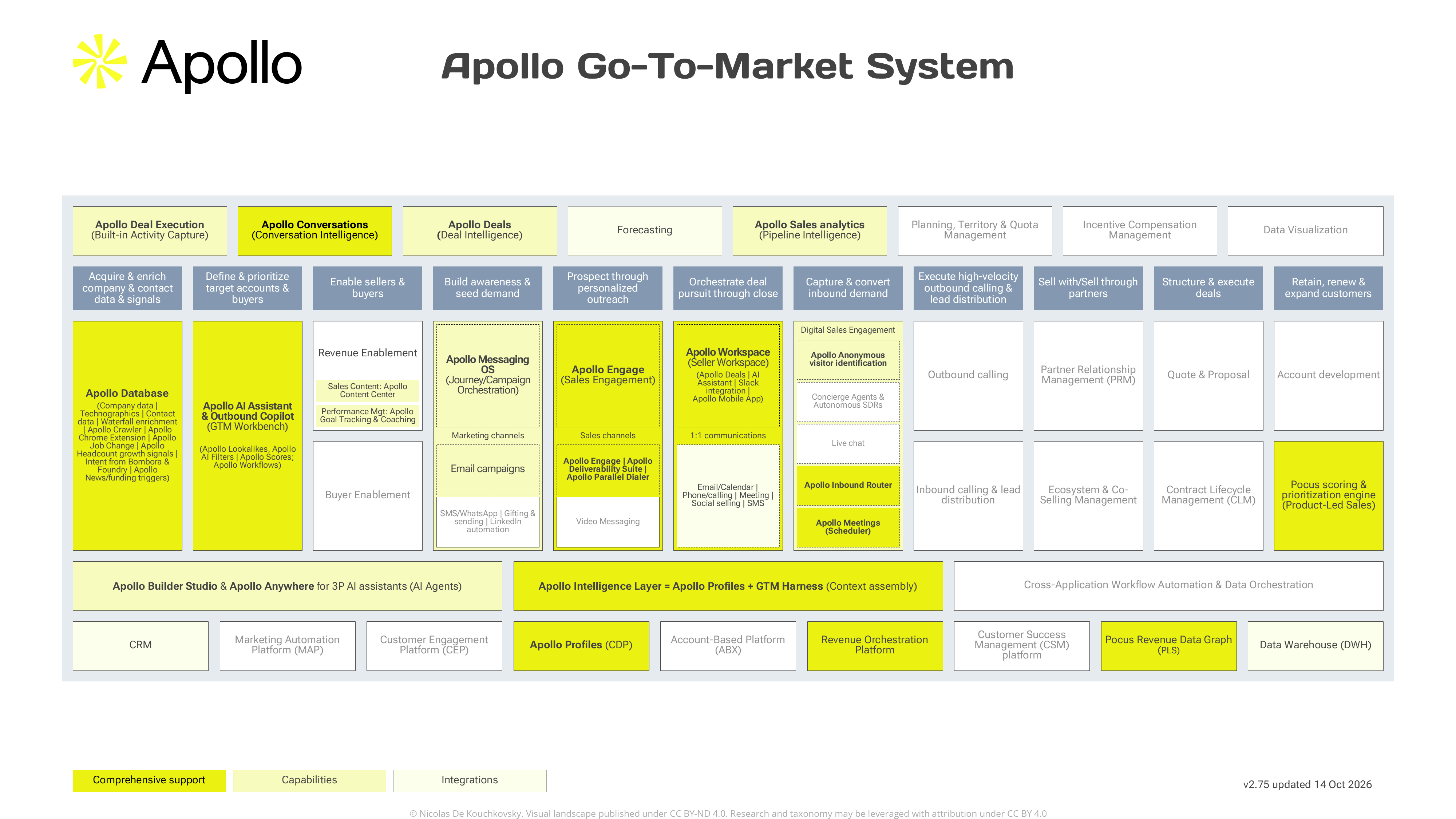
Thanks to its freemium model, Apollo boasts more than 6 million users worldwide. In February, the company reported that it was approaching $200 million in ARR, with nearly 100,000 paying customers. Given its scale and presence in 100 Fortune 500 companies, it is somewhat surprising that Apollo wasn’t featured in either Forrester’s Wave for Revenue Orchestration Platforms for B2B or IDC’s MarketScape for Unified Revenue Orchestration Platforms.
Regardless, Apollo is a vendor worth putting on the radar. It’s time to stop thinking of Apollo as just a sales intelligence provider and recognize it as a comprehensive, integrated GTM platform.