


Earlier this month, I published a new revenue technology blueprint. I now want to start a series that takes a closer look at its key building blocks, starting with systems of record and the workflow and agentic layer.
Organizations run on systems of record. They capture data, embed business logic, and serve as the operational backbone of the business. It all started with CRM, which became the system of record for commercial relationships and pipeline management: accounts, contacts, opportunities, and deals.
The rigid CRM data model, centered on the lead-to-account-contact-opportunity lifecycle, quickly became a constraint for marketers. This gave rise to Marketing Automation Platforms (MAPs) such as Eloqua and Marketo. Built around a flatter, person-centric model, they became the systems of record for first-party lead data and campaign engagement.
The same rigidity later drove the emergence of Account-Based (ABX) platforms from vendors such as 6sense and Demandbase. They became the systems of record for account-level intent, signals, and engagement.
Similar limitations for post-sales motions led to the emergence of Customer Success Management (CSM) platforms from vendors such as Gainsight and Totango. They aggregate product usage and other account-level signals, becoming the systems of record for customer health and expansion by combining product, relationship, and commercial data.
The rise of product-led growth also spawned a new, albeit short-lived, category of Product-Led Sales (PLS) platforms from the likes of MadKudu and Pocus. They became systems of record for user-level product engagement, combining telemetry, user and account context, and third-party enrichment to support freemium-driven sales motions.
This proliferation of systems drove enterprises to build Data Warehouses (DWH) on platforms such as Databricks and Snowflake to create a unified view of their customers. These data warehouses became the systems of record for enterprise reporting and AI modeling, consolidating customer, account, and event data across the business.
Their analytics-oriented nature made them ill-suited for real-time marketing and sales engagement. This gap led to the emergence of Customer Data Platforms (CDPs) from providers such as Segment and Tealium, which became the systems of record for unified first-party events and signals, customer profiles, third-party attributes, and identity resolution.
More recently, two new platform categories have emerged. Customer Engagement Platforms (CEPs), such as Braze and Klaviyo, combine CDP capabilities with real-time customer engagement across channels, becoming systems of record for customer interactions and engagement orchestration. At the same time, Revenue Orchestration Platforms (ROPs), such as Gong and Outreach, have consolidated conversations, sales activities, and customer interactions, becoming systems of record for sales engagement and execution.
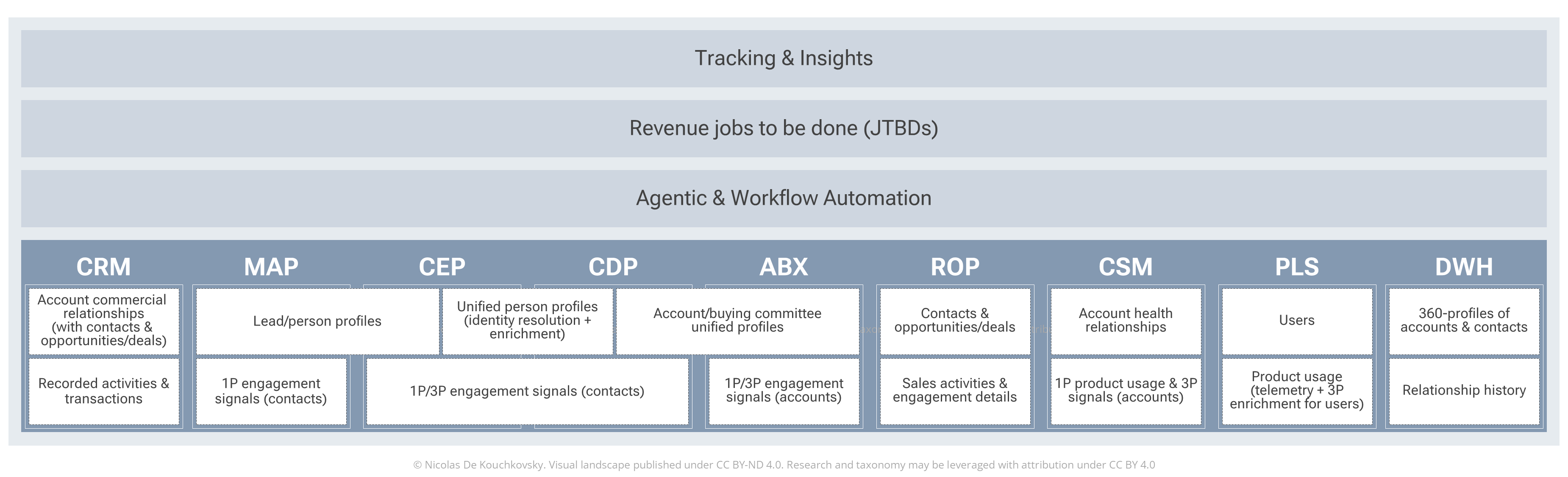
Today, most businesses rely on a combination of these systems. Taking inventory of your data estate is a critical first step in designing an integrated revenue stack. And when evaluating a provider, you need to understand whether it should serve as a system of record and, if not, how it integrates with existing systems while preserving their integrity.
This systems-of-record layer forms the foundation of the revenue stack.
Above it sits the workflow automation and agentic layer. Before the rise of agentic AI, workflow automation platforms helped synchronize data and orchestrate processes across systems of record and the broader revenue stack. Representative vendors include Zapier and newer players such as n8n.

AI agents represent the next evolution of workflow automation. Rather than following predefined rules, they can operate autonomously toward a goal. They can also replace some of the workflows embedded within the revenue applications that make up your stack.
Agents can be specialized or custom-built. While many practitioners are experimenting with building their own, most organizations should assume a mix of vendor-provided and custom agents.
Agents are now coming from all corners of the market:
Foundation model and AI platform providers such as Anthropic, OpenAI, and cloud hyperscalers AWS, Google, and Microsoft.
Workflow automation providers such as Make, n8n, and Zapier have added agent-building capabilities.
Your systems of record providers have likely embedded agents directly into their applications.
Large enterprise application providers such as HubSpot, Microsoft, Oracle, Salesforce, SAP, and ServiceNow are increasingly offering agentic platforms that extend beyond their software and can orchestrate work across a broad range of business and sales processes.
Ultimately, every application across the revenue stack will embed agents.
New agent-native platforms purpose-built for revenue teams, such as Lindy AI, Lyzr, Relevance AI, Rox, and Swan.
Before introducing new providers into your environment, start by inventorying the agentic capabilities already available from your existing strategic vendors.
While the debate over agent development strategy rages, from customizing prebuilt agents versus building from scratch to selecting the right platform, too little attention is being paid to the context that makes agents effective.
The middle box of the agentic layer is intended to rebalance that discussion and foster the design of the context cornerstone, assembling elements such as semantic definitions and connected datasets that enable effective agents. And when using the blueprint to map a vendor’s offering, elements such as context graphs and MCP should be captured there.
That’s all for this first double-click. Comments welcome!