


2025 marked a turning point for sales and revenue technology. For years, vendors and pundits predicted SalesTech consolidation, yet progress remained incremental. Unified go-to-market platforms have now matured and are beginning to replace fragmented point-solution stacks. AI has been instrumental in this shift, making it straightforward to layer agents onto solid data foundations and expand supported sales motions.
Against this backdrop, I’m launching a series to explore what the market’s consolidators have to offer through a jobs-to-be-done lens. I begin with Apollo, which introduced its all-in-one platform and agentic capabilities at its Next event last November.
Data foundation
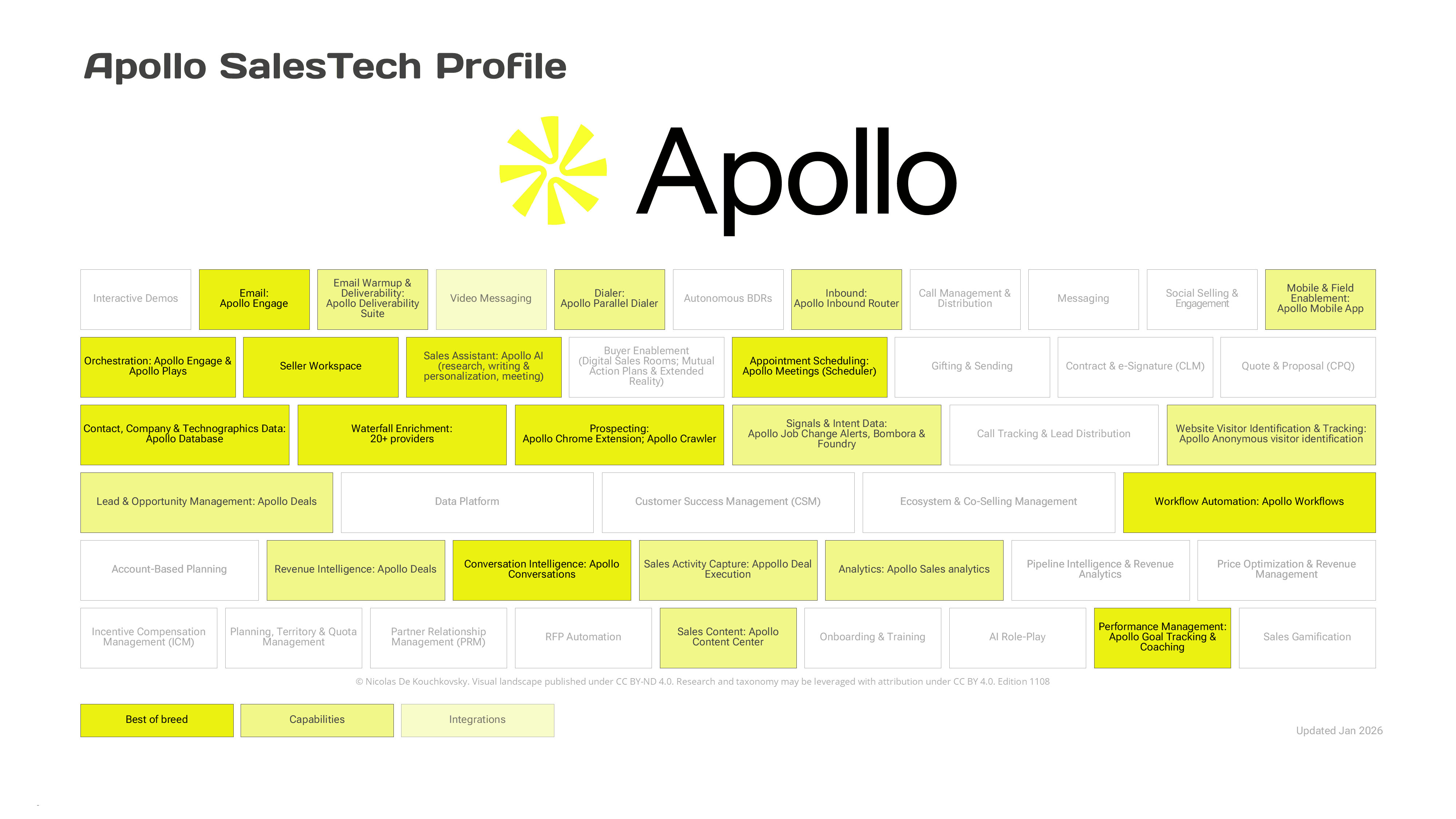
Apollo maintains a proprietary dataset of 200 million accounts and contacts, including technographic details. Its network of 2 million contributors keeps contact data current and accurate. Its Deliverability Suite monitors emails and provides closed-loop feedback on address accuracy. For intent signals, it combines proprietary web crawling with data from Bombora and Foundry. It recently added waterfall enrichment, letting you control the order in which sources are queried.
Users can manage account and contact stages, as well as deals and tasks. All activities in Apollo, including emails, calls, and meetings, are captured automatically, along with recordings from meeting platforms and its own dialer. These objects can all be synced back to CRM. Apollo also includes a content center that ingests website content and other key assets to feed its messaging engine, enabling personalized communications.
Targeting & segmentation
Apollo Projects serves as the workbench for building lists and campaigns, guiding AI context gathering. The AI Assistant lets you describe your ICP in plain English and identify your total addressable market. You can refine it using custom attributes pulled from the web. Apollo can also find lookalikes based on selected accounts. You can then apply account scoring to prioritize your lists, and once finalized, source contacts with scoring models that assess relevance and likelihood to engage.
Prospecting
Apollo Engage lets you enroll your lists into prospecting sequences across email, LinkedIn tasks, and voice. Apollo AI Assistant supports account and contact research, sequence design, and messaging using the content center. The Apollo Deliverability Suite handles mailbox warm-up, rotation, and email verification. In November, Apollo added a parallel dialer with call guides, local presence, and voicemail drops, completing its sales engagement platform.
Appointment-driven inbound
Apollo manages inbound leads from your website, starting with visitor identification at both contact and account levels. It handles form enrichment, scoring, lead routing, and meeting scheduling. Apollo Workflows let you define a frictionless buyer experience end-to-end.
Deals
Apollo lets you manage deals and tasks directly in the platform. It features a unified, role-based workspace with access to all suite capabilities via the left-side navigation. Reps can also use a mobile app and a Chrome extension for prospecting. A meeting assistant supports pre-call research and post-call activities, with Apollo AI generating follow-up tasks and recommendations. Customizable pipeline views and a deal dashboard, including research, insights, interaction history, and tasks, complete its deal management module.
Tracking & Insights
Apollo automatically logs all outbound prospecting, inbound lead management, and deal activities. Call and meeting recordings are processed through its conversation intelligence module, letting you create playlists for onboarding and training and score these interactions to drive sales coaching. Analytics draw on this comprehensive data to track campaigns, outbound prospecting, inbound web engagement, seller performance, call and email effectiveness, and pipeline.
In 10 years, Apollo has built one of the most comprehensive go-to-market suites. At SaaStr Annual 2024, founder and CEO Tim Zheng reported over 80,000 paying customers. By May of last year, the company announced 2 million users and $150 million in annual recurring revenue, signaling strong traction in the mid-market. It’s time to reset perceptions of Apollo as only a data provider.