


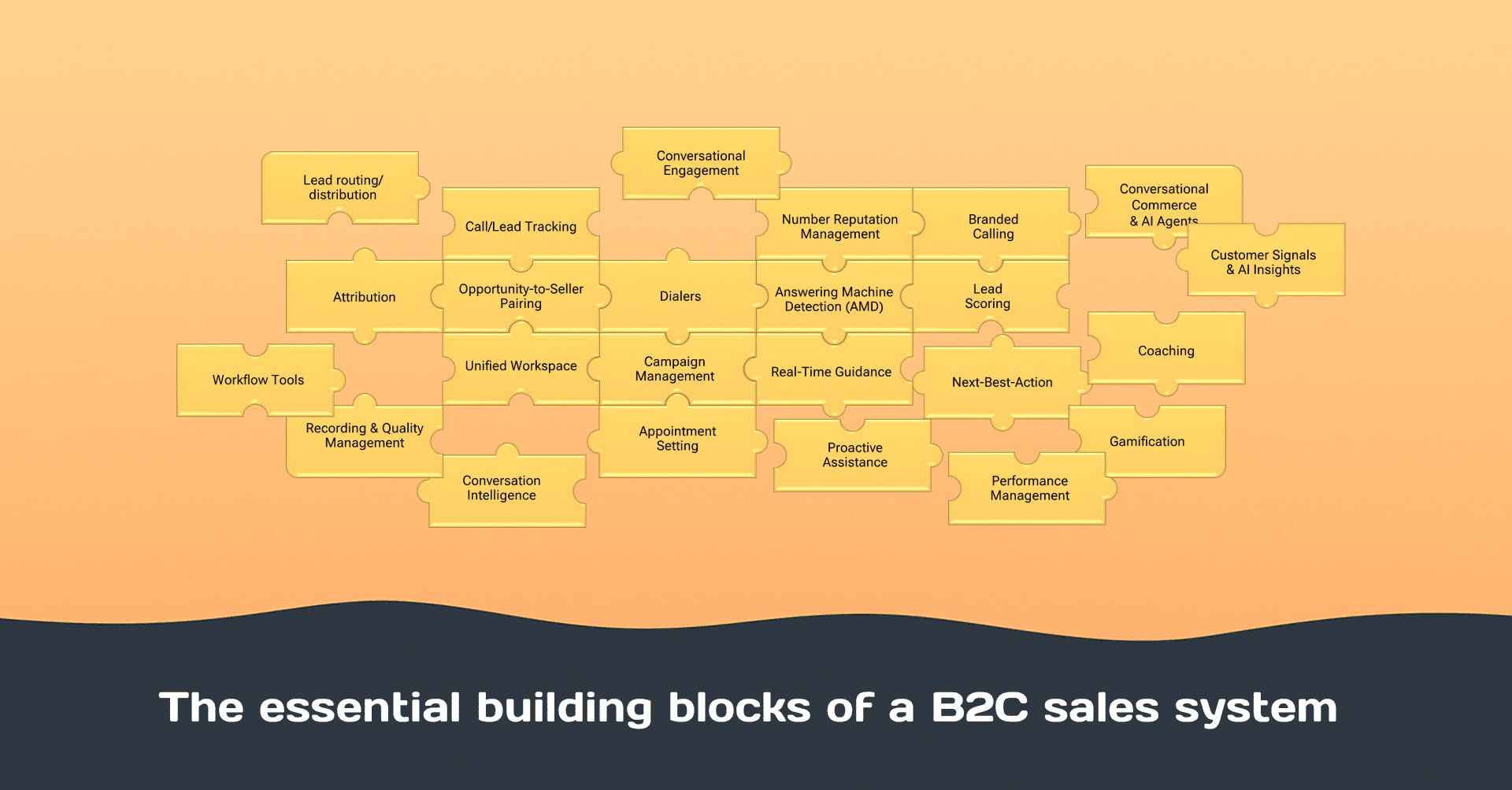
In part one, we explored why modernizing sales operations has become a top priority for B2C businesses. This second segment focuses on the foundational building blocks that enable varied sales motions and buyer journeys.
Lead conversion
Converting inbound leads hinges on effective distribution strategies. While contact center-style routing remains common, many sales organizations achieve superior results through targeted approaches: ensuring equitable access to high-quality leads, rewarding top performers with priority allocation, or leveraging AI to match each lead with the seller most likely to close.
In B2C environments, tracking inbound inquiries from advertising campaigns, including TV, Google, and social media, is critical for measuring performance and ROI. Complexity rises in franchise models such as automotive retail or insurance, where brands generate leads centrally and distribute them to dealers or agencies. It further escalates when leads originate from lead generation providers and are shared across multiple businesses, making speed of response paramount. “Speed-to-lead” is also critical for transactional sales, where the first seller to engage typically wins. This competitive imperative requires real-time lead prioritization and, when immediate follow-up is not possible, placement into re-engagement campaigns.
Meeting these requirements necessitates robust call and lead tracking, lead scoring capabilities, advanced opportunity-to-seller pairing algorithms, dialers with instant callback functionality, and multi-channel campaign management.
Digital journeys
Websites and social networks can no longer be left unattended. Relying solely on self-service is insufficient because buyers expect guidance as they navigate complex decisions. Traditional chat solutions often fail, with qualified associates unavailable or response times too slow.
Conversational commerce and AI agents are now acting as concierges to deliver near-human interactions, letting prospects explore on their terms while providing instant assistance for any question. When a customer signals readiness to buy, the interaction can be handed off to a human seller, scheduled for an appointment, or directed to a targeted outbound follow-up, keeping the buying experience fluid.
Sales Engagement
Voice remains the most effective channel for closing sales, with dialers forming the backbone of outbound operations. Advanced dialer techniques—power, progressive, or predictive—enable B2C teams to maximize the time sellers spend with prospects and customers on the phone. These modes leverage answering machine detection (AMD) technologies.
However, dialers alone are insufficient. Modern outbound operations require support for sophisticated call flows such as dropping personalized voicemails, bridging calls from inside sellers to field sellers or closers, and orchestrating multi-channel engagement sequences that combine SMS, messaging, email, and voice. Orchestrating these steps across channels depends on powerful workflow tools.
Outbound selling has grown increasingly sophisticated, and no dialer can operate effectively without a campaign manager. Sales campaign managers extend far beyond segmentation. They enforce compliance by scrubbing calling lists for Do Not Call registrants, opt-outs, and known litigators, while managing follow-up cadences in accordance with evolving privacy and prospecting regulations.
Unlike marketing campaigns with virtually unlimited sends, sales campaigns operate within a finite pool of sellers. A sales campaign manager adds essential nuance by optimizing the human capital, including balancing multiple campaigns competing for the same sellers, sequencing digital and human touches, and selecting the optimal time to call.
Privacy regulations and the FCC’s SHAKEN/STIR mandate have carriers flagging potential spam calls. Each carrier uses its own model, making number reputation management critical to any outbound strategy. These solutions continuously monitor phone number performance, assign premium numbers to high-value calls, and remediate or replace those flagged as spam. Brands are also adopting branded calling to reinforce trust and improve answer rates.
Managing the whole journey
Most businesses fail to follow up with leads that are not ready to buy. Conversational engagement transforms lead nurturing by making re-engagement possible at scale. Generative AI now mirrors human responses and can read a prospect’s emotional state. While humans are often pressed for time to convert a lead, AI adapts its pace to the prospect, engaging at their rhythm, answering questions, and adjusting to the buyer’s stage and concerns with precision. The most advanced AI agents are already opening new pathways to warm leads and maximizing conversion.
Onboarding new customers, while not strictly a sales activity, has become a critical step in the buying journey and can make or break a sale, in particular when it needs to go through an application process like a mortgage. Even when digitized, exceptions can derail the experience, making proactive assistance essential. For complex products like banking, effective onboarding combines step-by-step education with proactive guidance. While much can be automated, brands increasingly need sellers or associates involved at key, dynamically identified moments. Delivering a smooth onboarding experience depends on uncovering moments or exceptions that require outreach using customer signals and AI insights, supported by appointment-setting tools.
Many B2C sales have become bite-sized, making upselling essential to realize full customer value. Repeat and subscription sales make customer retention critical, with many such opportunities surfacing during service interactions. Conversation intelligence must be tuned to identify these revenue moments. Capitalizing on service-to-sale opportunities hinges on a next-best-action engine to surface them and real-time guidance systems that prompt sellers with recommendations tailored to customer emotions, objections, and concerns.
Tracking and optimization
Reps must be equipped with workspaces built for speed and precision. They need streamlined interfaces that surface critical information above the fold to minimize context switching, arranged in intuitive layouts that reduce cognitive load. With many B2C sales decided in the first encounter, real-time guidance and personalized coaching during conversations are essential, helping sellers make the most of the moment.
Measuring sales activities goes beyond tracking revenue. It requires visibility into productivity and the specific behaviors that drive performance. Every interaction must be captured and analyzed through quality monitoring, conversation intelligence, and performance management systems, with optional gamification to accelerate best-practice adoption and continuous improvement.
With a significant share of sales conversations originating from advertising and marketing campaigns, a closed feedback loop is also essential. Tracking and attribution must tie each engagement back to its source and often extend across business boundaries when leads are shared, giving organizations clear insight into which investments drive results and where to optimize.
An ecosystem in the making
Most B2C businesses still need only a subset of these capabilities, but the list is expanding as organizations that once relied on a single acquisition engine now run a mix of sales motions across their book of business. At the same time, they increasingly require technology tailored to B2C sales journeys and can no longer depend on generic B2B sales or contact center solutions. As organizations adopt more software and lean on best-of-breed capabilities, stitching together a stack of point solutions is starting to show its limits. This is driving demand for suites that simplify integration and unify how the various sales motions are executed.
A few B2B salestech vendors have been adapting their offerings for B2C in areas such as conversation intelligence, real-time guidance, role-play, coaching, and gamification. The most meaningful moves, however, are coming from UCaaS and CCaaS providers, along with pure-play specialists. Contact center vendors such as Five9, with its Acqueon acquisition, and NiCE, through its acquisitions of LiveVox and ContactEngine, are expanding their stacks. Several UCaaS vendors, including 8x8, Dialpad, RingCentral, and Zoom, have made sales a core use case and introduced sales-focused products.
B2C-focused providers are also broadening their platforms, whether from the outbound side with Conquer, Convoso, Readymode, and Regal, or from the inbound side with CallRail, CallTrackingMetrics, Convirza, and Invoca.
It is time to treat B2C sales as a distinct market with its own requirements.