


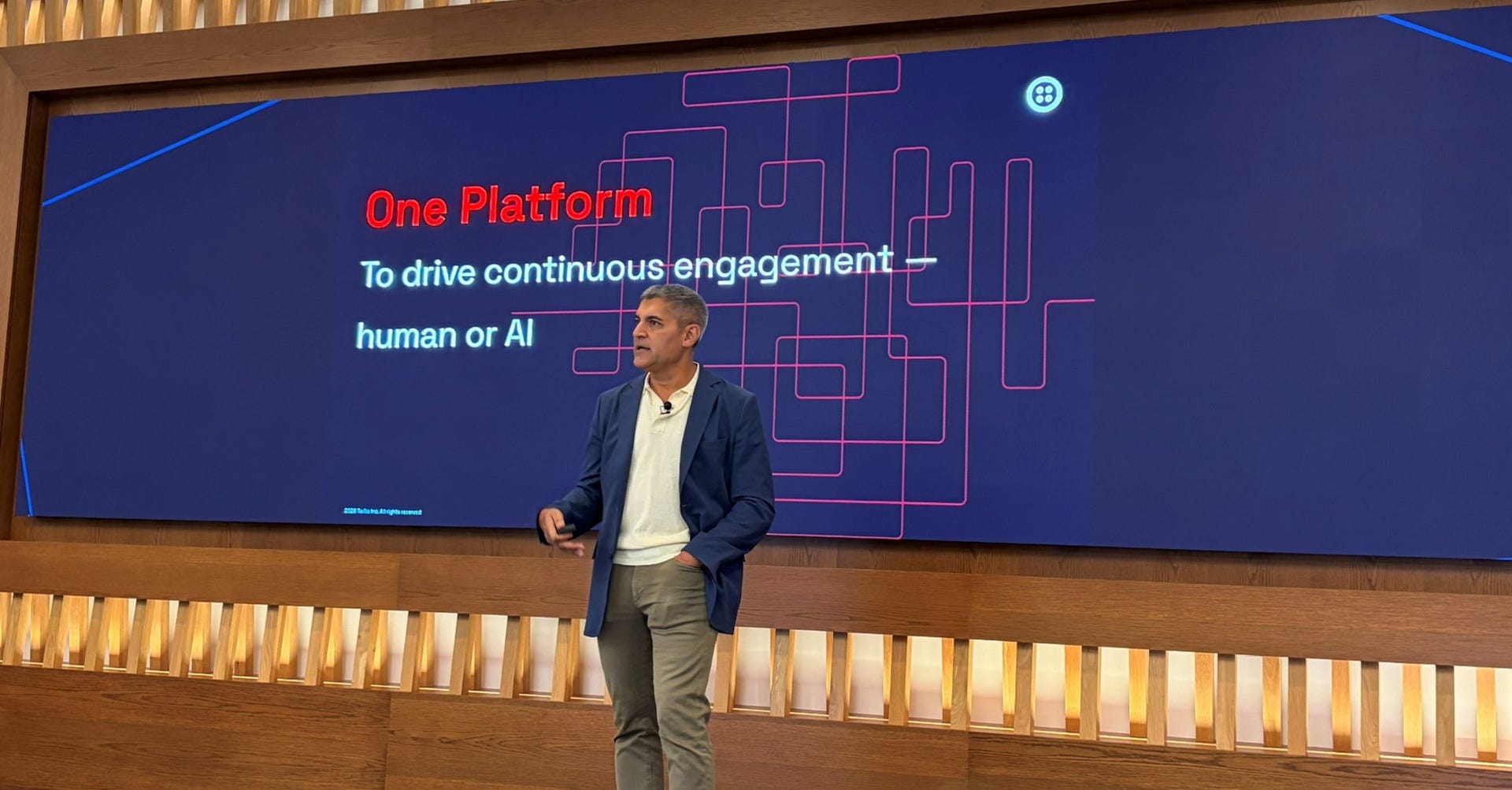
On the heels of its 1Q26 earnings call, Twilio hosted its Analyst Summit and Signal conference, where it unveiled new products alongside a new positioning.
Before getting there, it is worth pausing on the company’s remarkable turnaround. Once a market darling, Twilio exited 2022 with over $1B in losses, $1B in debt, and gross margins below 50%, entering a period of significant restructuring and strategic reset. Early 2024, Khozema Shipchandler, previously the company’s CFO, succeeded founder Jeff Lawson as CEO.
The financial turnaround was largely achieved in 2024, but it came at the cost of six consecutive quarters of stagnant growth, which led markets to question the durability of the long-term opportunity. In early 2025, Twilio shared a double-digit growth ambition. The latest quarterly results, 20% year-over-year growth after five consecutive quarters of sustained double-digit expansion, were rewarded with a sharp increase in market valuation, setting the stage for what the company is now positioning as its next chapter.
The company has spent the past couple of years unifying its portfolio, including its SendGrid (email) and Segment (CDP) acquisitions, an effort that culminated at Signal with the unveiling of a new Console giving developers a unified entry point across its products.
The next act for the company is to become the infrastructure for the agentic era, enabling continuous customer engagement with humans and AI. At Signal, it launched its conversation layer, adding three new building blocks to Conversation Relay:
Conversation Orchestrator enables continuous conversations across channels with both human agents and AI agents. It enables seamless channel switching, multimodal interactions, AI-human handoffs, and automated outreach for follow-up or notification.
Conversation Memory adds persistent context across interactions. It aggregates customer traits (profiles), identifiers, observations (signals extracted from conversations, such as behavior, sentiment, and preferences that can be manipulated semantically), and interaction summaries.
While leveraging Segment technologies, Conversation Memory is CDP-agnostic and can also connect to any CDPs, CRMs, and data warehouses. For AI agents, Twilio can further enrich context with knowledge through its Enterprise Knowledge ingestion module.
Conversation Intelligence lets you take actions in real-time on live conversation streams. It features a framework that uses language operators. These operators, either from Twilio or custom-built, include surfacing contextual knowledge recommendations, delivering real-time guidance, enabling intelligent routing and next-best actions, monitoring script adherence, and detecting sentiment and conversational signals.
Conversation Intelligence differs from Conversational Intelligence, Twilio’s post-conversation analytics solution, which is now evolving into a new product, Conversation Insights, that will combine the analysis of structured and unstructured data.
The conversation layer also includes Agent Connect, which integrates these building blocks into agentic platforms while abstracting away conversational complexities such as streaming and turn-taking. It supports OpenAI, Microsoft Azure, AWS Bedrock, Anthropic, and LangChain/LangGraph. It’s open-sourced and can be adapted to other frameworks.
Twilio has refocused on APIs and building blocks. That shift has reignited momentum with ISVs, a business that had been hindered by Twilio’s earlier ambitions toward packaged applications. In January 2025, Twilio disclosed that ISVs represented roughly a quarter of revenue, with the segment consistently outgrowing the broader business since then.
Serving both enterprises and ISVs across organizations ranging from SMBs to the world’s largest companies creates inherent positioning challenges. Twilio addresses the diversity of needs across these segments by marketing a collection of modules. While it makes it easy for builders to pick what they need, it can take some stepping back to see where the platform is heading.
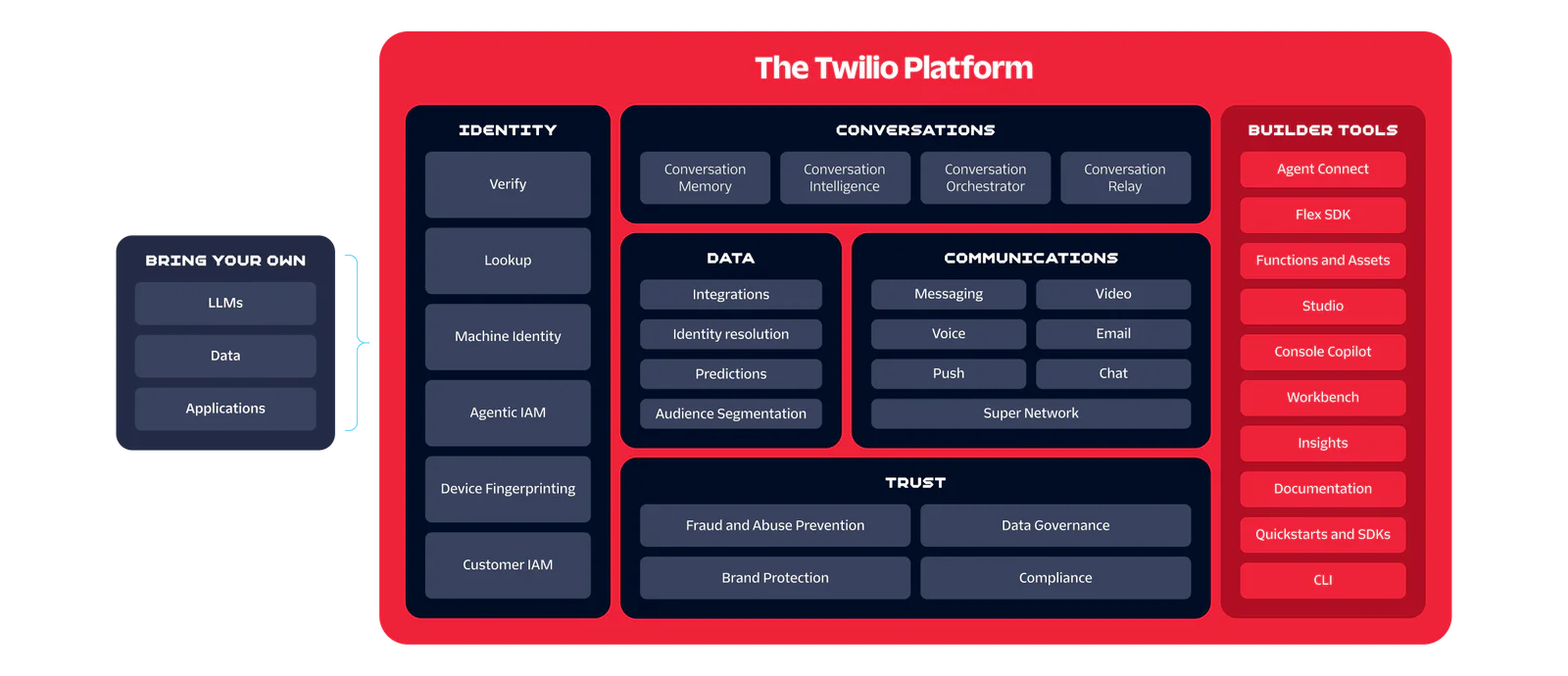
Twilio is reshaping itself into an infrastructure provider for customer engagement in the AI world. Looking across its moves, three pillars are taking shape, each rooted in foundational requirements for customer engagement in the agentic era. First, conversation management with its newly unveiled layer. Second context, with Segment getting not only modularized but also embedded in other building blocks. Third identity and trust, with Twilio extending its authentication capabilities through its Stytch acquisition to support AI agents and expanding into compliance and fraud detection.