


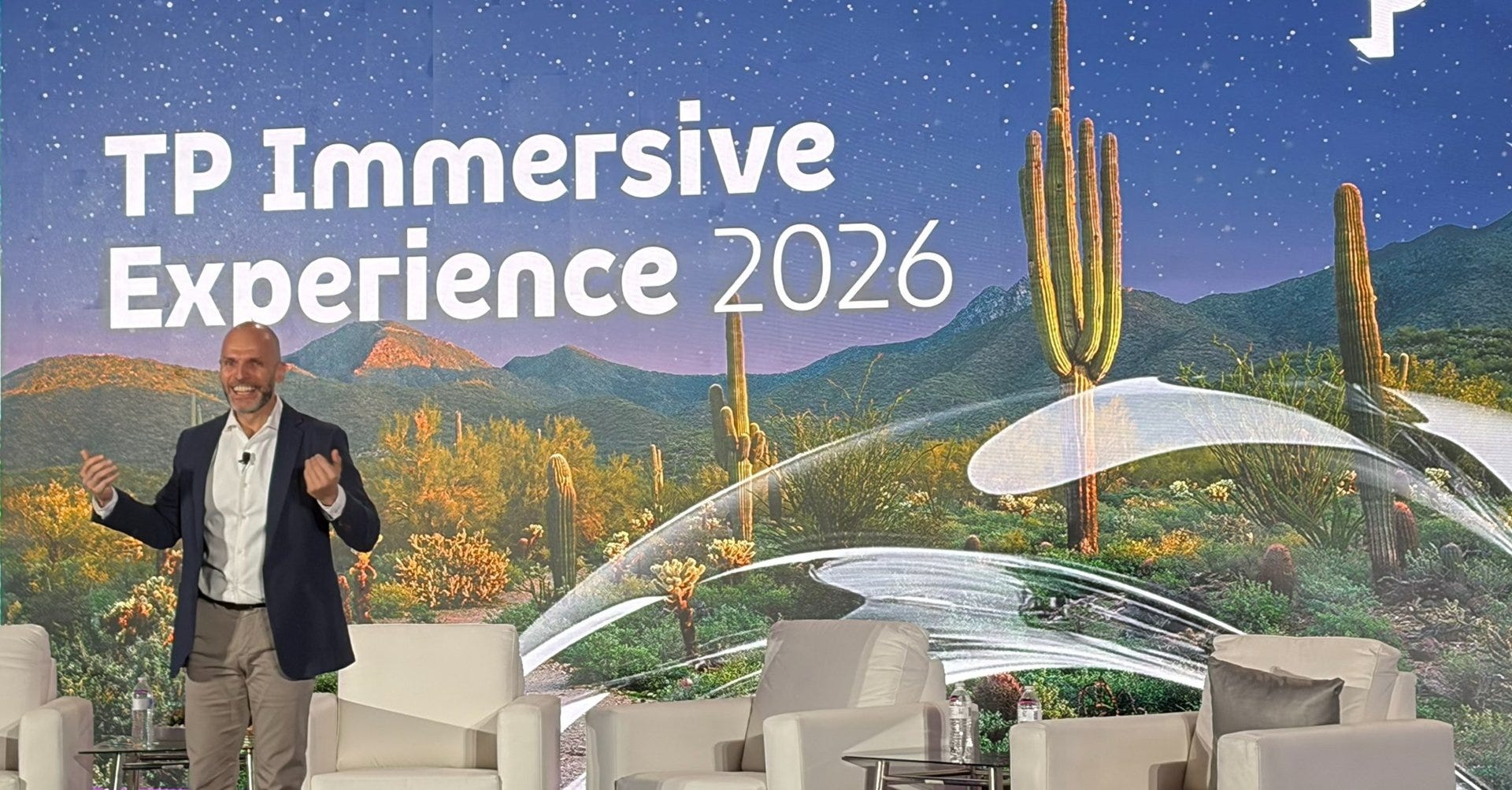
I attended the TP Immersive conference earlier in May.
With Jorge Amar recently appointed as CEO, it was a timely opportunity to take the pulse of an industry at a crossroads. In February, he took the helm of the company founded 50 years ago by industry legend Daniel Julien, succeeding him.
Jorge came from McKinsey, where he was already working on TP’s strategic transformation before taking the CEO role. He stepped in with a clear conviction: TP sits at the center of the workforce transformation AI is about to unleash.
BPOs are first in line for AI disruption. A significant portion of their revenue still comes from the “butts and seats” model built around entry-level roles that AI agents are poised to replace. Under mounting pressure, BPOs are reshaping their business profiles by diversifying into higher-value services, moving up the value chain through more end-to-end process ownership, and shifting toward outcome-based models.
TP operates a large workforce and has to handle significant turnover. Over time, that has made it highly proficient at hiring, onboarding, and continuous training. This creates a foundation for transitioning workers into the new roles that Agentic AI will inevitably create.
Interestingly, a growing number of businesses struggling to realize the expected financial returns from their AI initiatives are turning to the BPO giant to take over functions outright, including the people, with the charter to optimize them.
BPOs are also “project factories.” They manage many projects and, with slim margins, profitability depends on disciplined execution, particularly around timing and delivery. TP is no exception. It worked on more than 500 AI projects last quarter alone, building deep expertise across both the technical and change management dimensions.
Last year, TP introduced TP.ai FAB, a platform designed to support its vision of humans and AI working together.
TP.ai FAB is built on an open framework that integrates with clients’ existing environments and incorporates technologies from selected partners, including Ema, Kore.ai, Parloa, and Sanas.
At the event, TP shared how it built five agentic solutions on top of this framework:
FAB Assist delivers a complete work environment for human agents, combining AI assistance, KPI-driven coaching, and Sanas voice experience improvements
FAB Connect provides an agentic customer self-service solution with escalation to human agents
FAB Operate optimizes traffic orchestration across contact centers and agentic self-service based on customer intents and desired outcomes
FAB Collect for collections and FAB Growth for sales are end-to-end solutions designed to maximize revenue outcomes through AI.
These solutions position TP to take on more outcome-driven engagements. One challenge, however, is that in multi-provider enterprise environments, the technology stack is often dictated by the customer.
Jorge explained that this transformation requires a fundamentally different conversation with customers. Success depends on the ability to deliver meaningful insight into what businesses should consider. Over the years, TP has built deep expertise across industries and business processes that it now needs to fully harness to earn that strategic seat at the table.
TP’s position at the intersection of technology, people, and large-scale delivery expertise gives it the right to participate in the emerging service market disruption. Key to its success will be the ability to realize definitional outcome-based projects within its customer base.