



On the heels of its fourth-quarter earnings, RingCentral hosted its industry analyst summit last week. Three key takeaways emerged.
The company continues to demonstrate strong execution. Over the past two years, it has adapted to a single-digit growth environment, reduced debt to $1.25 billion, grown free cash flow to over $500 million, and achieved GAAP profitability.
The summit was led by Kira Makagon, celebrating her first year as President and COO. Vlad Shmunis, founder and CEO, joined for the Q&A. The team, a mix of veterans, boomerangs, and newcomers, conveyed a strong sense of alignment across all functions.
RingCentral is all-in on AI and business communications, dedicating over 60% of its engineering investments to developing new AI-based products. Several have already launched and are enjoying strong adoption. This is worth celebrating, given the challenges many face with AI adoption.
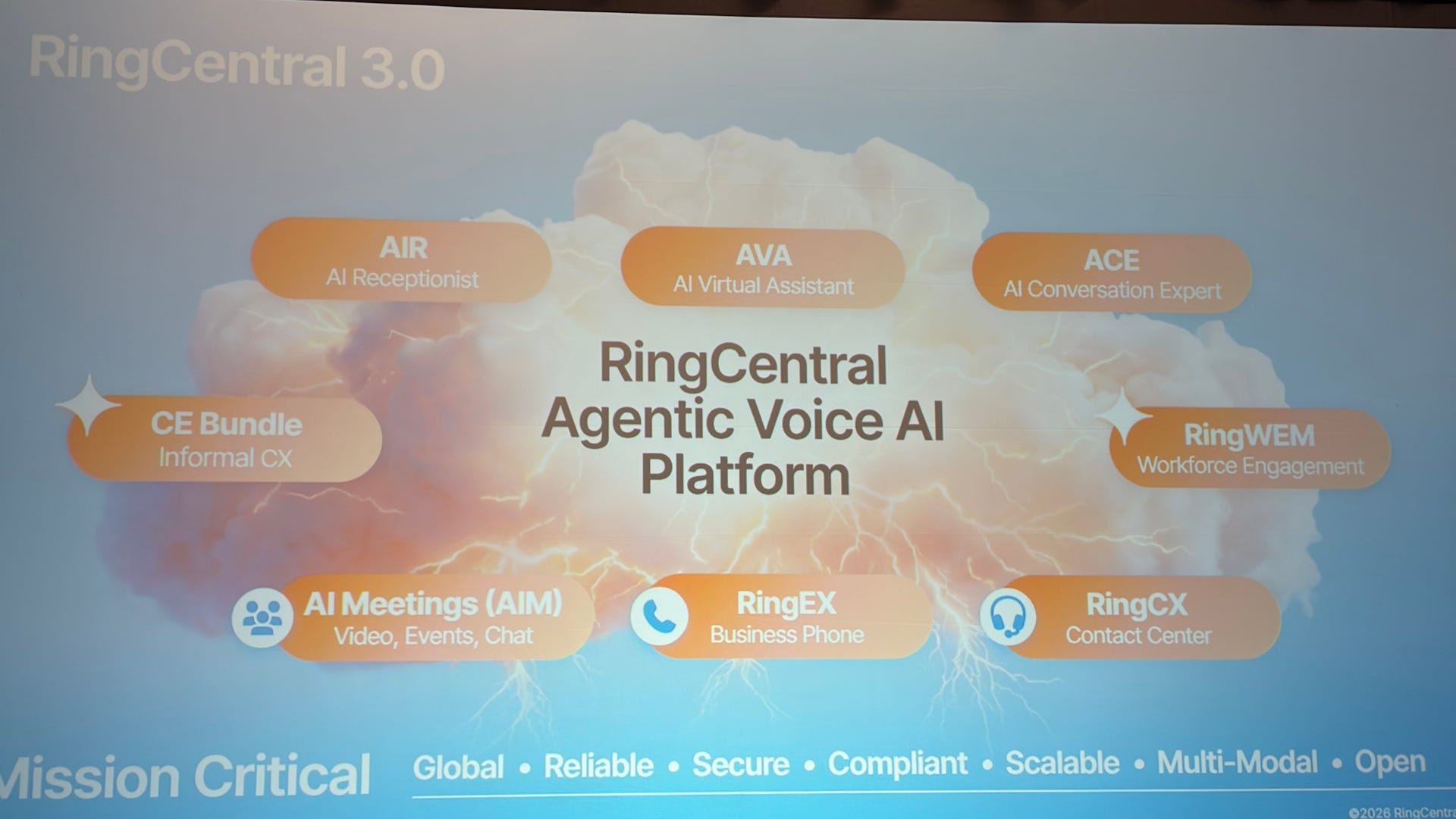
AI Receptionist (AIR) is a concierge agent delivering a unified front door across departments. AIR handles appointment booking, lead capture and qualification, and transfers to a human based on detected intent. Introduced a year ago, it has reached over 8,000 customers. Last November, RingCentral launched its AI Virtual Assistant (AVA) to support human employees. Together with AI Conversation Expert (ACE), formerly RingSense, they form the company’s “three As”—AIR, AVA, ACE. Each represents a potential entry point for applying AI and, over time, can be combined into a virtuous automate-assist-automate loop.
Also last November, RingCentral launched a customer engagement bundle, extending its RingEX communication solution to provide contact center-like voice and SMS capabilities to roles that are not full-time contact center agents. In just a few months, it surpassed 1,000 customers, highlighting market demand to expand the CX discipline and eliminate friction in customer interactions across departments.
Introduced two years ago, RingCX, RingCentral’s homegrown contact center solution, was recently enhanced with RingWEM, which combines recording, quality, and workforce management following the CommunityWFM acquisition. It now serves 1,500 customers and likely accounts for a substantial portion of the $100 million in ARR attributed to new products.
The product presentations and demos demonstrated the care and precision that went into tailoring these solutions for their target markets. AI Receptionist and AI Virtual Assistant, in particular, are designed for zero-effort setup and flywheel-driven improvement, enabling distribution through a product-led motion.
On the go-to-market (GTM) front, RingCentral’s success comes from elevating discussions from technical infrastructure to business impact. The company has been developing an approach tailored to its target industries, with granular vertical definitions driving effectiveness—focusing on clinics rather than the broader healthcare sector, for example. This enables highly specific conversations on where its AI solutions can deliver impact. This evolving GTM is well received by partners, enabling the company to leverage its well-established global service provider and Technology Services Distributor (TSD)/Technology Advisor (TA) channels.
RingCentral increasingly uses the term business communications. While generic in meaning, for the company, it refers specifically to essential interactions between a business and its current or future customers. RingCentral doesn’t see AI replacing human-to-human communication; on the contrary, it observes these interactions increasing within its customer base. They include customer service inquiries with contact center agents, sales conversations, communications between patients and healthcare providers, and more. Traditionally, these were handled separately—contact center software for customer service and unified communications for internal and external messaging. RingCentral’s new portfolio aims at unifying them into a continuum while harnessing AI to drive impact.
RingCentral describes its third act as RingCentral 3.0, aiming to become the front door for both human and AI agent interactions. In a crowded market, the company emphasizes its robust, large-scale communication infrastructure—a foundation built over a quarter century. Its comprehensive business communications approach, coupled with disciplined execution and a targeted focus on industries and use cases, makes its strategy very promising.