



At its annual user conference, Xperience 2026, Genesys unveiled an ambitious product vision that marks the beginning of its latest act, staking out a new market it intends to pursue.
After CTI, routing, omnichannel, and cloud contact centers, this fifth act harnesses agentic AI to move Genesys beyond interactions into resolution workflows.
The timing is notable. Genesys Cloud continues to grow at more than twice the market rate. Yet Genesys is making a significant bet on what comes next, expanding its ambition from managing customer interactions to orchestrating customer requests and desired outcomes.
The company has the financial strength to make that bet. Genesys Cloud ARR reached nearly $2.9B, up 30%; AI ARR hit $400M, up 60%; and first-half revenue grew 20%. Genesys also reported new financial metrics, including a 30% GAAP operating margin and more than $500M in free cash flow for the same period.
At the event, Genesys introduced several new products and presented a restructured product portfolio to execute on this vision.
Genesys Navigator is the first new product. It is a customer-facing agent that acts as a business front door, pulling together the relevant context, understanding customer intent, and routing the inquiry to the right “actor” to handle it, human or AI.
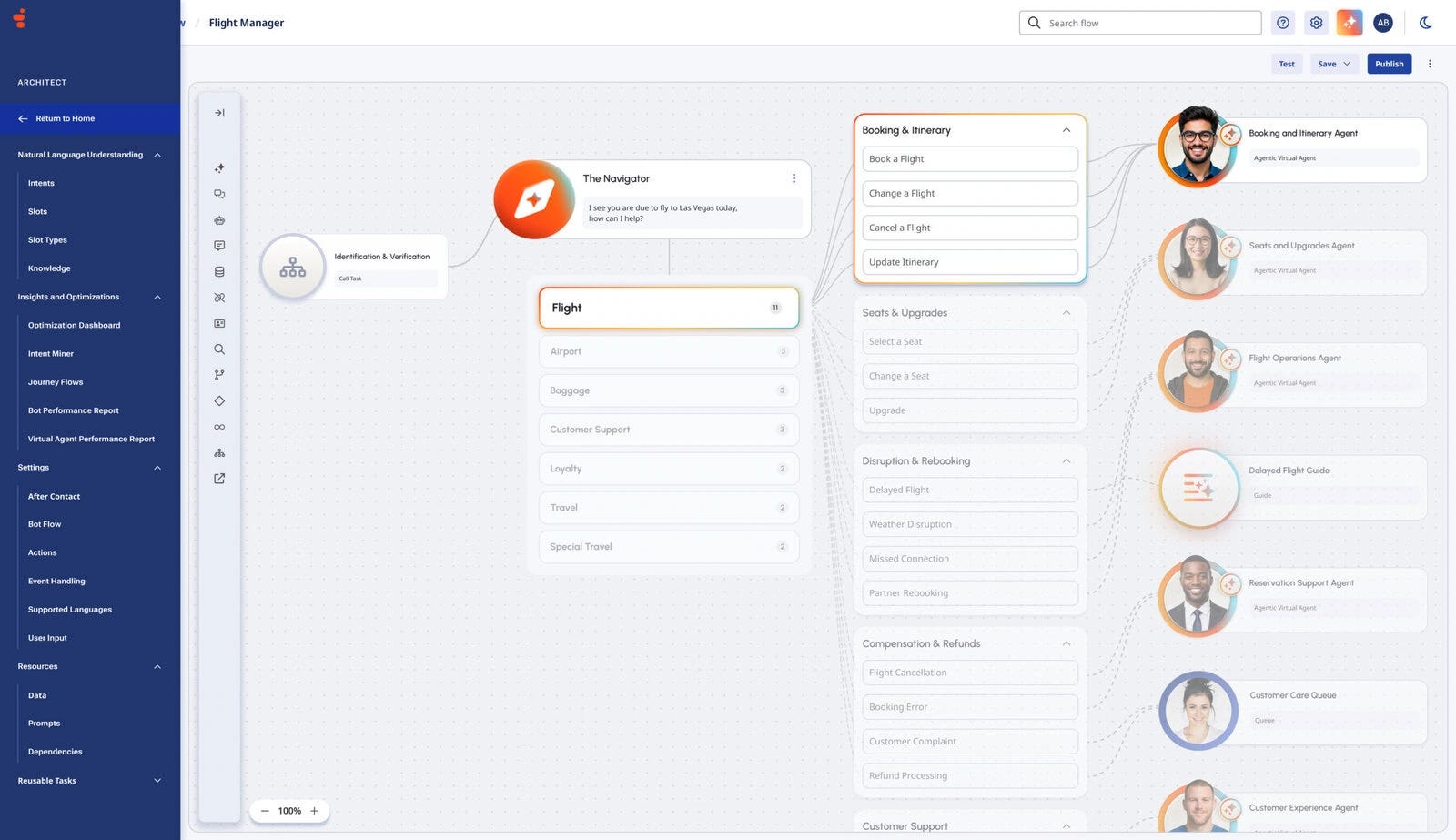
Genesys has purposefully divided the roles between Navigator and actors. Navigator uses a general-purpose model to understand why the customer is reaching out. Actors such as Genesys Agentic Virtual Agents (AVA) are focused on resolving the request. AVA uses Scaled Cognition’s new APT-2 Large Language Model (LAM), which Genesys says reduces hallucinations. It now also benefits from Pinkfish declarative workflows and MCP integrations that significantly broaden the scope of actions it can take.
Genesys Orchestrator is the second, and arguably most significant, new product announced. Orchestrator is context-aware and manages multi-step journeys toward desired outcomes. Steps are delegated to an actor: a human interaction or work item, outbound outreach, or any of the automations Genesys supports, including Guides, Workflows (Pinkfish), first-party agents such as AVA, or third-party agents via A2A.
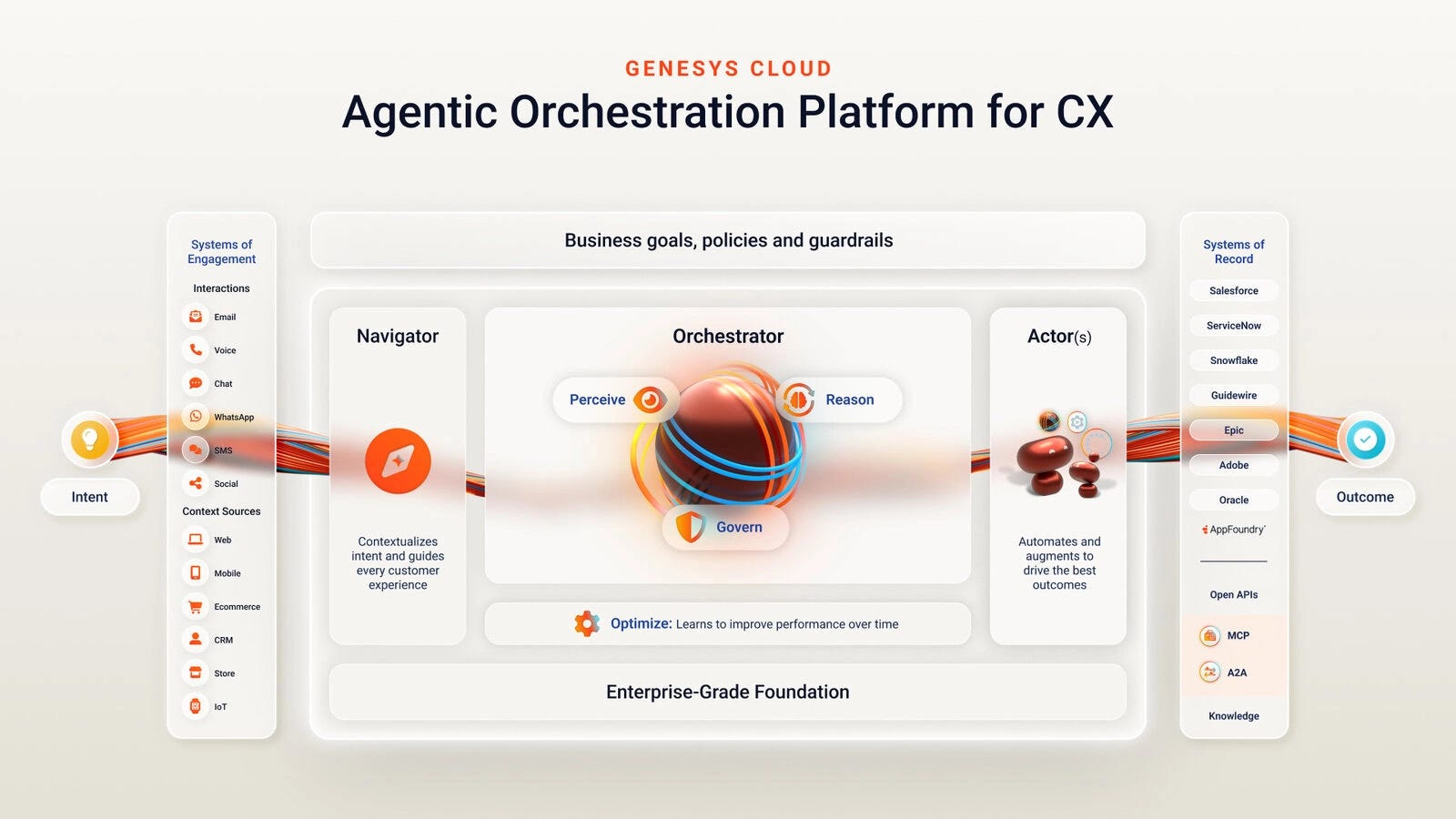
Orchestrator is fundamentally a decisioning engine, not just a workflow and journey orchestration tool. It uses a newly introduced, proprietary specialized model, Kaleidoscope, which Genesys explained was created to make sense of policies, context, intents, and events to determine the desired outcome and the next best delegation towards that goal, strictly within the policies, guardrails, and scope defined by the enterprise. Genesys resolutely positions Orchestrator as autonomous. The ambition to rely entirely on autonomous decisions in a world of customer service where predictable and repeatable processes have traditionally reigned supreme is audacious.
Navigator is expected to reach general availability in Q4 FY27, followed by Orchestrator in Q1 FY28.
This ambitious undertaking rests on two essential capabilities: context and control. Genesys AI Control Plane centralizes governance and provides observability for these autonomous steps, while Genesys Contextual Intelligence maintains persistent context by connecting interaction signals, customer identity, history, business events, and journey data.
It felt like Genesys wants to break away from the traditional CCaaS market, almost as if it were willing to burn bridges with it.
Why make such a sweeping move now, when Genesys Cloud continues to perform so strongly?
My read is that Genesys is anticipating slower CCaaS market growth and intensifying competition from hyperscalers, CRM providers, and Conversational AI specialists, and is moving on the offensive to expand its addressable market.
What Genesys unveiled at Xperience 2026 is a bold move. Following NiCE last year, Genesys is now setting its sights on resolution workflows, an increasingly contested market with CRM and other technology providers.
CCaaS players are all striving to redefine and expand their market. Many have adopted CX platform terminology without clearly defining how their newly minted CX platform differs from CCaaS. Genesys has taken a serious stab at answering that question.