


I attended Fin Pioneer in early October.
Fin is an extraordinary story. Founded in 2011 as Intercom, the company initially focused on in-app messaging before expanding into customer service software. It crossed $200M in ARR in 2021, but growth later stalled.
When ChatGPT launched in November 2022, founder Eoghan McCabe had just returned to the CEO role. Seeing an opportunity, he bet the company on AI, launching Fin as a customer support AI agent in 2023 and redirecting most product resources toward this undertaking.
The bet paid off. By early 2026, Fin was approaching $100M in ARR. In May, Intercom rebranded the company as Fin, retaining Intercom as the name of its help desk software. A month later, Salesforce announced its acquisition of the combined business, which was a little over $300M in revenue, for $3.6B.
Following the acquisition’s close, Salesforce confirmed at Dreamforce that it would retain the Fin brand and product. It also plans to leverage Fin as a product-led growth (PLG) entry point into its broader portfolio.
Fin serves more than 12,000 customers, mostly SMBs, but also has some large deployments. Anthropic, for example, shared its experience at the event. Fin was adopted by Salesforce for its help center. Initially handling 5% of inquiries, Fin was ramped up to 40% of the volume handled by the juggernaut within a few weeks.
Fin started as a generative answer solution. The company has consistently reported the percentage of customer inquiries its AI can resolve across its customer base. That figure has now reached 76%. Along the way, Fin developed the proprietary Apex family of models, purpose-built for customer service.
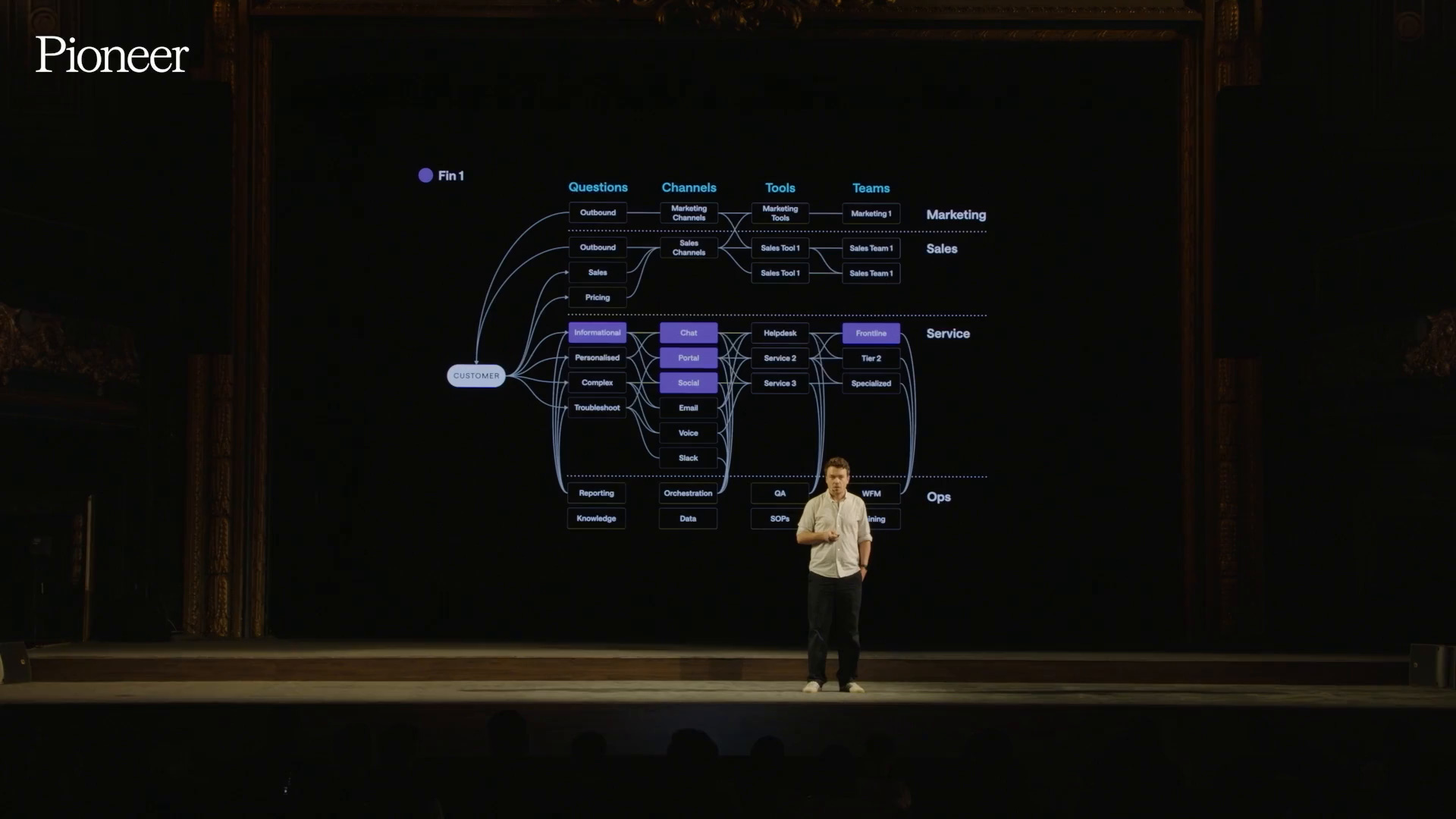
CPO Paul Adams walked us through Fin’s evolution: from answering informational questions (Fin 1), to handling personalized queries and accessing enterprise systems (Fin 2), to resolving complex issues through structured procedures and simulations (Fin 3). The company also expanded Fin across interaction channels, adding support for email, voice, and Slack.
In April, it introduced Fin for Sales, an inbound sales solution that engages website visitors, answers product questions, guides prospects toward trials or purchases, qualifies leads, books meetings, and routes prospects to sales teams.
Fin 4, unveiled at the event, marks the next step. It extends Fin’s ability to tackle ambiguous, complex problems through reusable skills and expands the agent beyond simply responding to incoming queries. Fin can now proactively pursue outcomes such as onboarding, feature adoption, and retention.
Fin’s broader vision for customer operations revolves around three components:
A Customer Agent that handles interactions across the customer lifecycle, spanning service, sales, and customer success. Inbound sales is already supported, while outbound sales remains part of the broader vision.
An Operations Agent that manages and continuously optimizes the Customer Agent.
A next-generation help desk, Intercom, redesigned for human-AI collaboration, including a rebuilt Copilot.
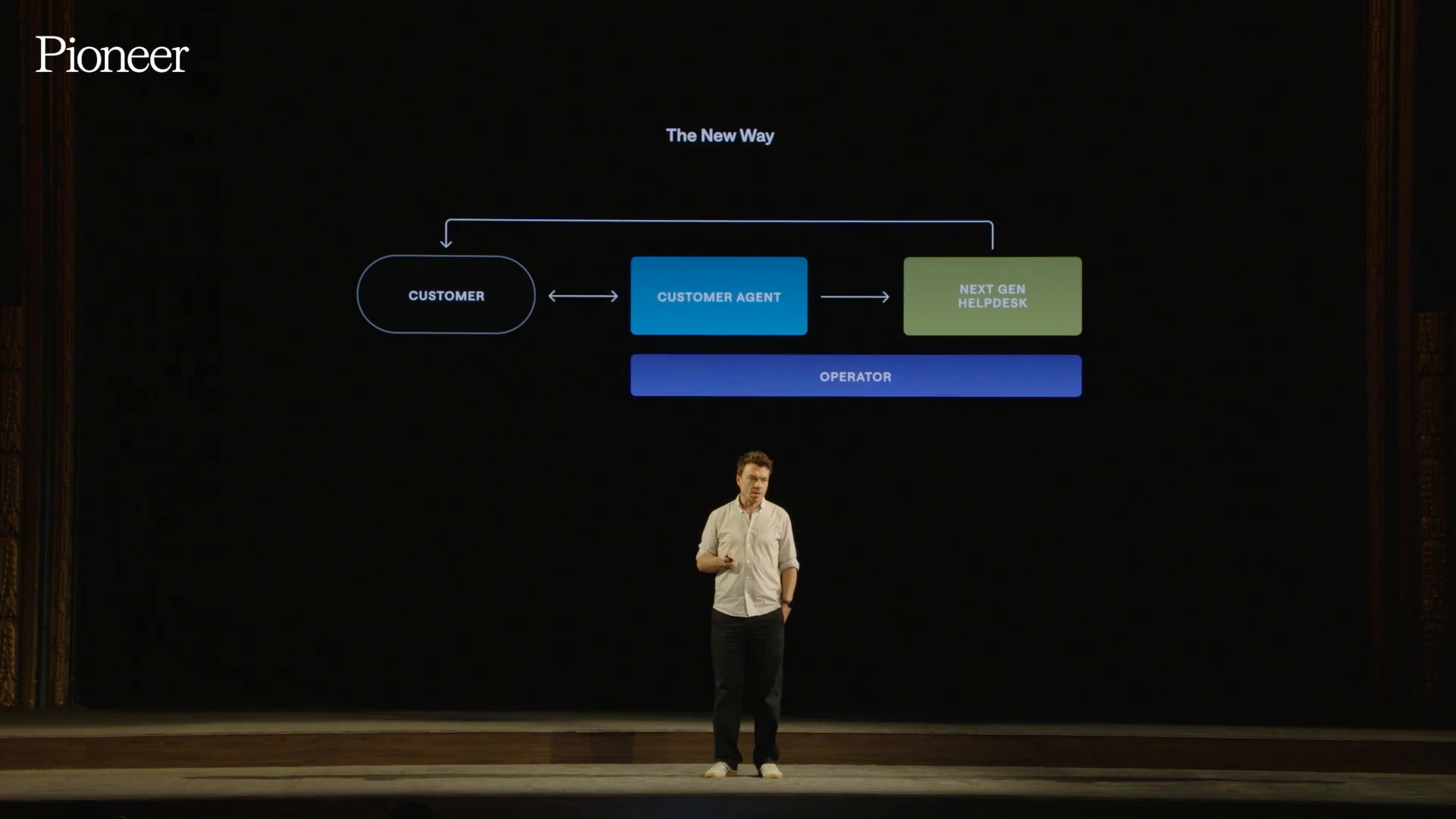
Operator, launched in May 2026, is the first embodiment of the Operations Agent. It analyzes customer service performance, identifies issues and knowledge gaps, and helps teams improve Fin. The longer-term vision is to make Operator autonomous and extend its operational capabilities beyond Fin itself.
Fin is pursuing an ambitious vision: orchestrating customer operations across not just service, but also sales and marketing. That vision is still taking shape, particularly on the sales and marketing side. Its track record of steadily expanding its agents’ capabilities makes it a credible one.