


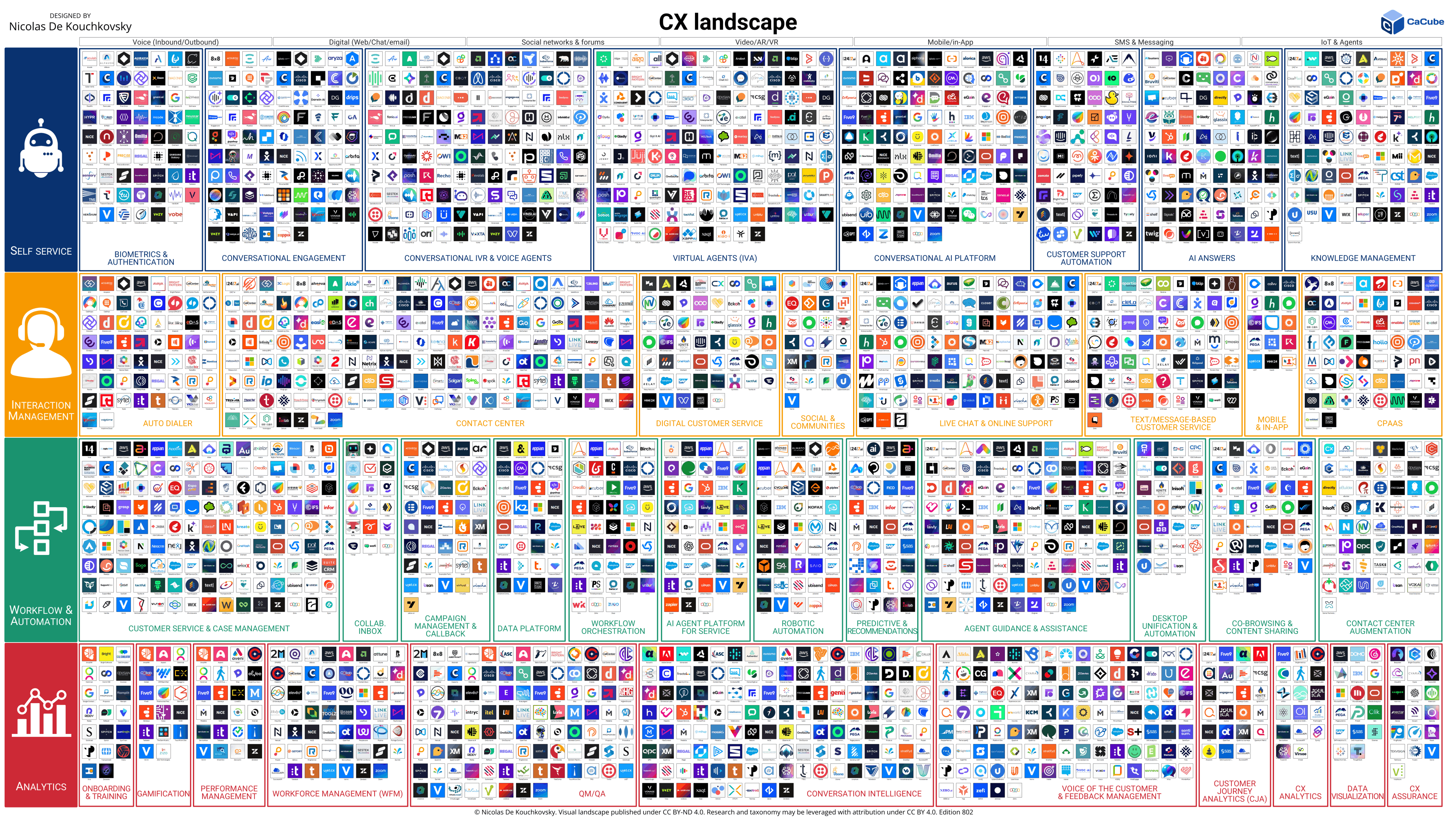
A little present before Christmas: the 8th edition of the CX landscape is out. I got it over the line before the end of the year.
The total number of participants grew by 12% since July 2024 to 1,300. CX remains a strategic and attractive market, and it delivers many of the top AI use cases. That growth should surprise no one.
Conversational AI and customer-facing agents drove the largest increase, with, in particular, a surge of new entrants in customer support automation and voice agents. The category is maturing fast. It was once a hyperscaler-led market with a long tail of small players. In 2025, several providers will cross $100M ARR, with a solid cohort over $50M.
Beyond customer self-service and agent augmentation, agents are emerging for workflow automation, driving the birth of an AI Agent Platform category.
Data platforms have made their coming out. For years, CRMs served as the reference customer data repository while other players positioned themselves as feeders of interaction details and dispositions into those systems of record. With AI, more providers now see the imperative for a comprehensive data foundation, consolidating interaction records, recordings, transcripts, and customer profiles into dedicated platforms.
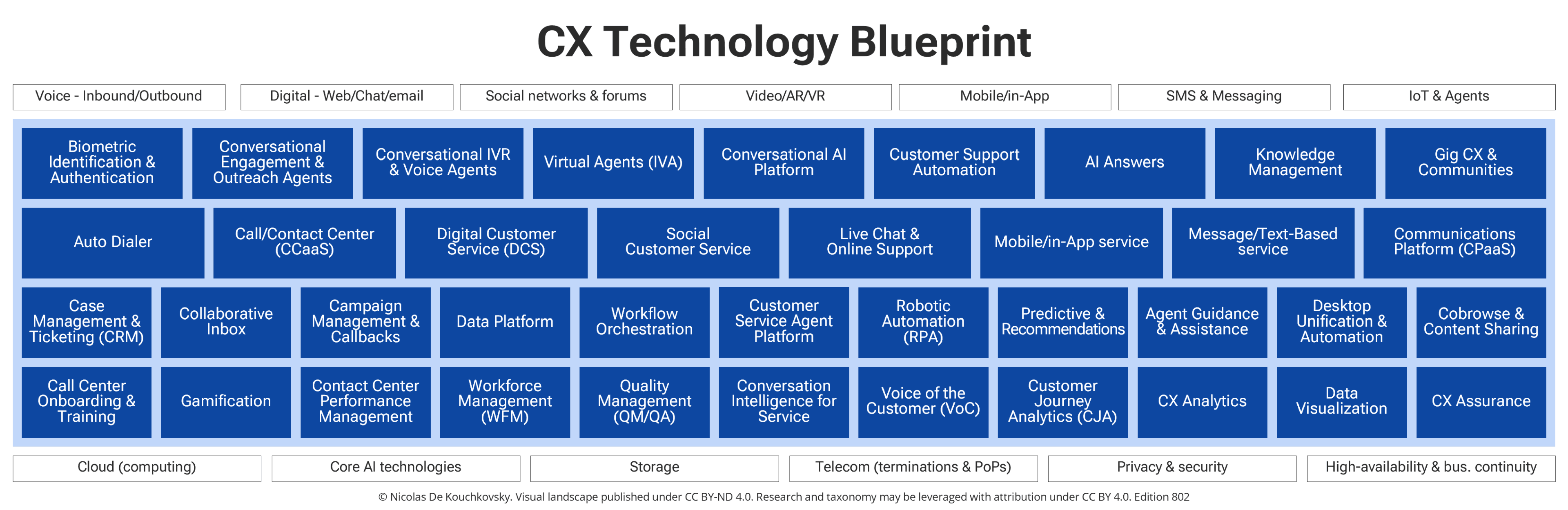
This 8th edition may well be the last to use the current construct.
I created the first version in 2017 based on a few assumptions:
Self-service would become the front door for service.
The system of engagement would be contested between interaction management platforms, including CCaaS with a voice lineage, Digital Customer Service with a digital channel lineage, and CPaaS with a messaging lineage, and workflow platforms, whether CRM or BPM/low-code platforms.
Analytics would remain a distinct layer, combining best-of-breed applications and aggregation platforms.
This framework has remained remarkably stable, evolving only slightly over the years.
As I reflect on the changes of the past year, it’s time to consider structural changes.
Data platforms are eclipsing interaction management and workflow software as the foundation of the CX stack.
Above this, an agentic layer will emerge, supported by a monitoring and control layer.
Self-service and human service, historically loosely coupled, will become tightly intertwined to enable new, collaborative motions.
Resolution and fulfillment workflows will become an integral part of the stack.
The CX stack will need to support not just service and support but also sales and retention, demanding new capabilities and accommodating these new roles.
Work allocation, once focused on instant distribution of inbound inquiries, will change. Combine the new roles to support, a more diverse mix of real-time, asynchronous, and deferred/scheduled interactions, and the growth of outbound driven by proactive service enabled by AI, and the result is a different work allocation model.
But that’s for next year...