



AI-related layoffs and workforce reductions continue to dominate headlines, with contact center employment often cited as being most exposed to AI-driven disruption.
Indeed, Agentic AI is reaching a level of capability where it can absorb a large share of first-level and transactional service interactions. Recent research highlights the scale of potential exposure: Anthropic found customer service roles to be among the most exposed to AI, with up to 70% of tasks potentially handled by AI. Similarly, Goldman Sachs estimated that a significant share of customer service roles are exposed to AI-driven automation.
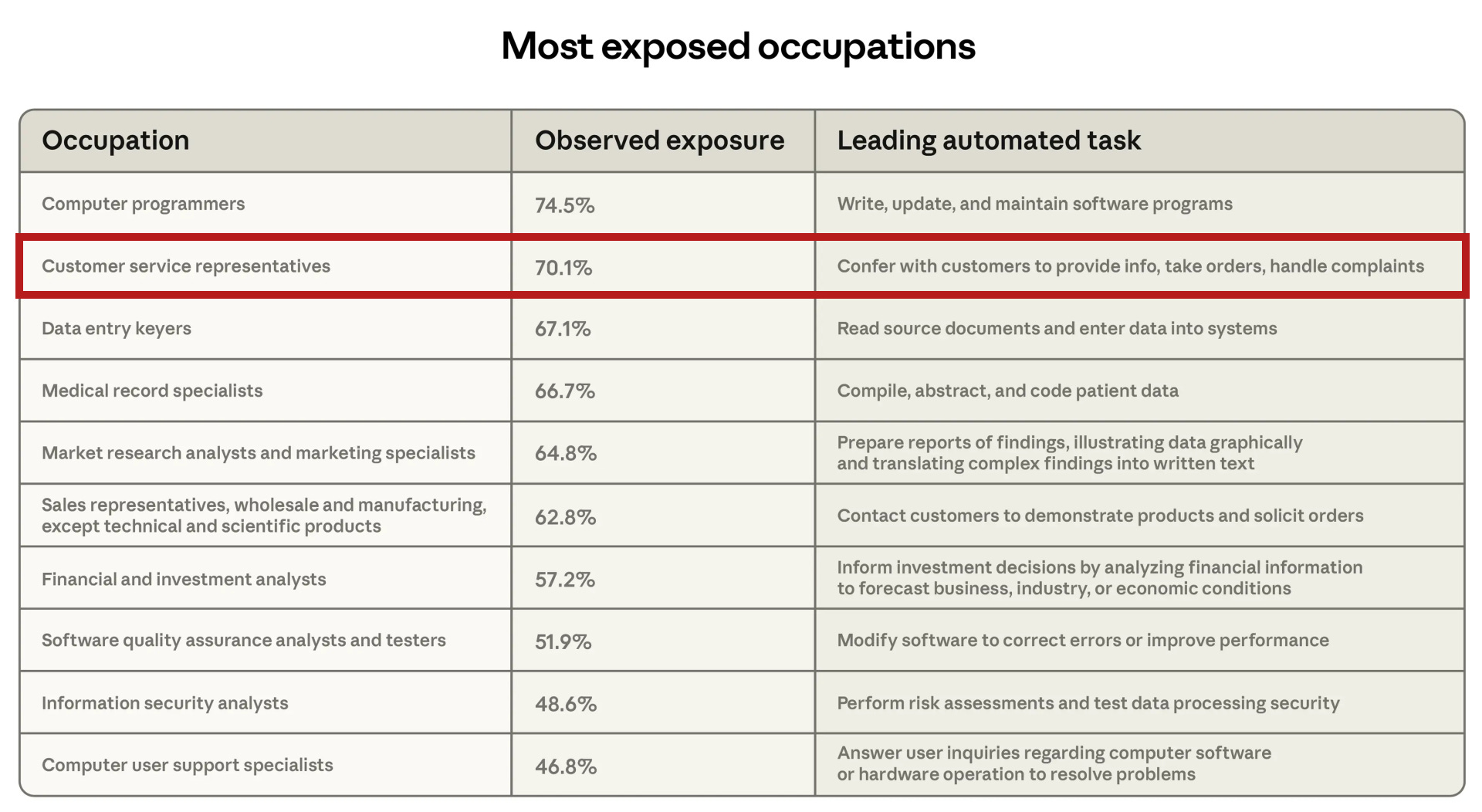
The US Bureau of Labor Statistics (BLS) recently published its annual employment-by-occupation report, offering a timely opportunity to assess the state of the contact center and customer service workforce.
For the second year in a row, employment of Customer Service Representatives has declined by 5%. The label Customer Service Representatives is somewhat misleading, as it encompasses only a fraction of customer service roles. Another category, Computer Support Specialists, points in the opposite direction. Last year, employment grew 2% after two years of 1-2% decline. This was a surprise, given that customer support automation is one of the most mature use cases for AI.
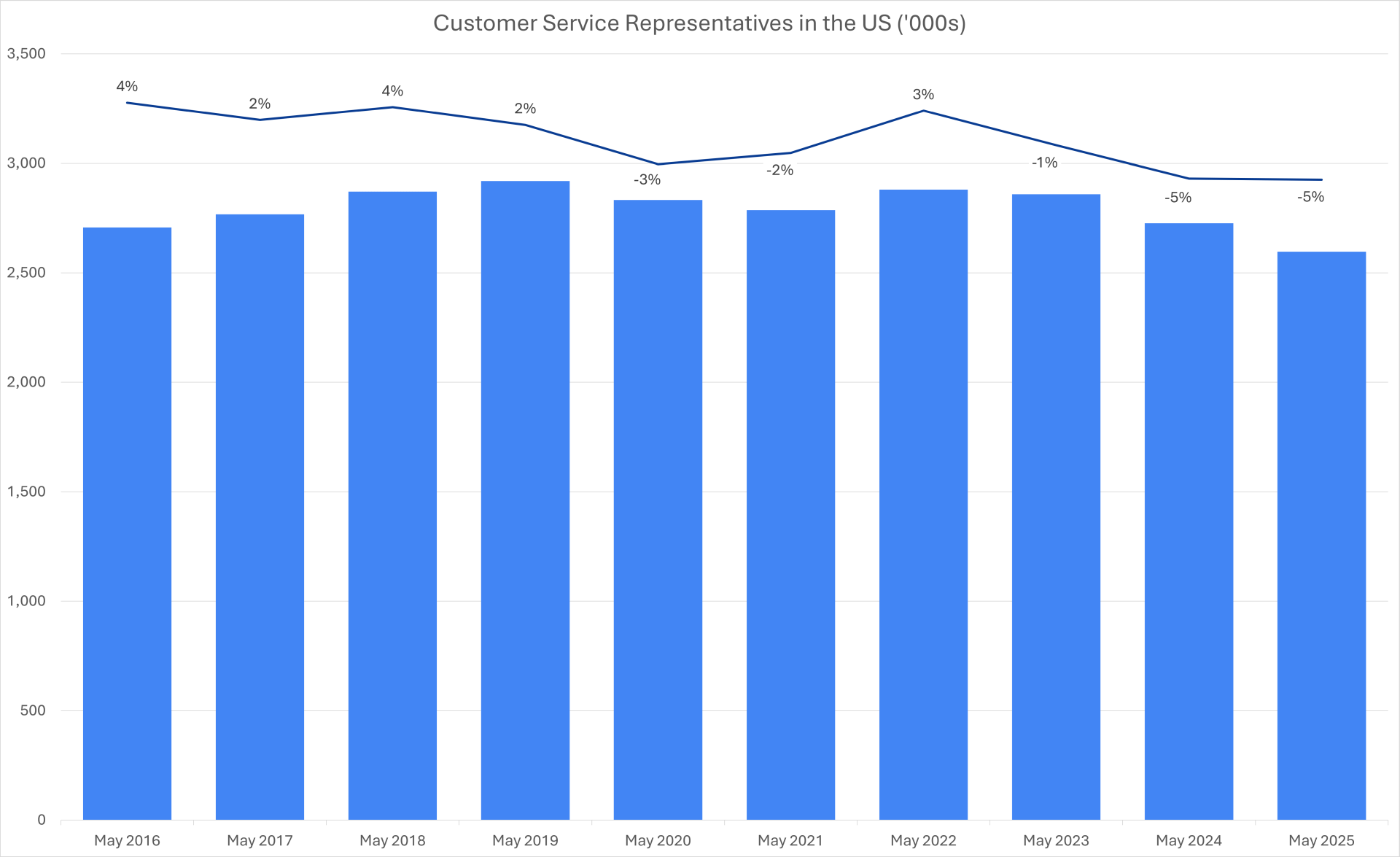
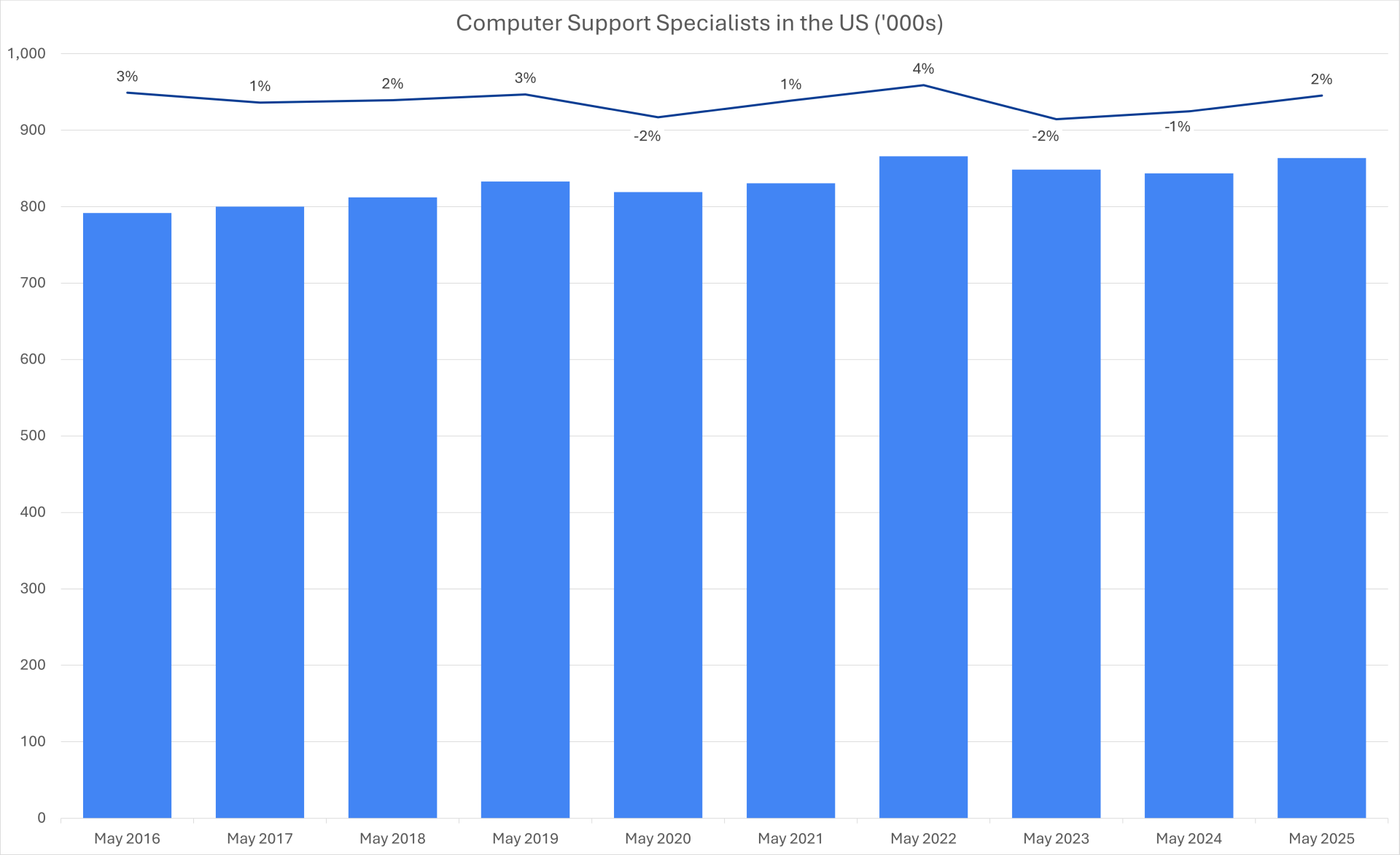
Combining the two categories shows a 7.5% contraction over the past three years. While Gartner’s 2023 prediction that AI will drive a 20-30% reduction in customer service and support agents by 2026 has not materialized, these numbers signal a structural decline.
But they only capture a fraction — 75% and declining — of the broader customer-facing workforce using customer communication technologies across the customer lifecycle. They do not capture the expansion of customer engagement activities, both in volume and across a broader set of roles across the enterprise.
First, we often assume a stable workload of interactions. In reality, while AI is absorbing a substantial share of interactions, volume and complexity continue to surge, offsetting much of the efficiency gains from automation:
The scope of activities handled virtually keeps expanding; COVID demonstrated that there is effectively no ceiling to what can be done remotely.
Processes are becoming more complex, driven in particular by mounting regulatory and compliance requirements.
Digitization is spreading across more processes, which generate exceptions, adding to customer service workload. In its Inner Circle Guide to Customer Interaction Analytics, ContactBabel found that 80% of complaints reaching contact centers are caused by back-office failures.
In parallel, the contact center’s managed communication infrastructure has extended its scope beyond traditional service into adjacent functions, including sales and service delivery, such as financial advisory or healthcare interactions.
Finally, the looming rise of agents acting on behalf of consumers will drive interaction volumes to new highs.
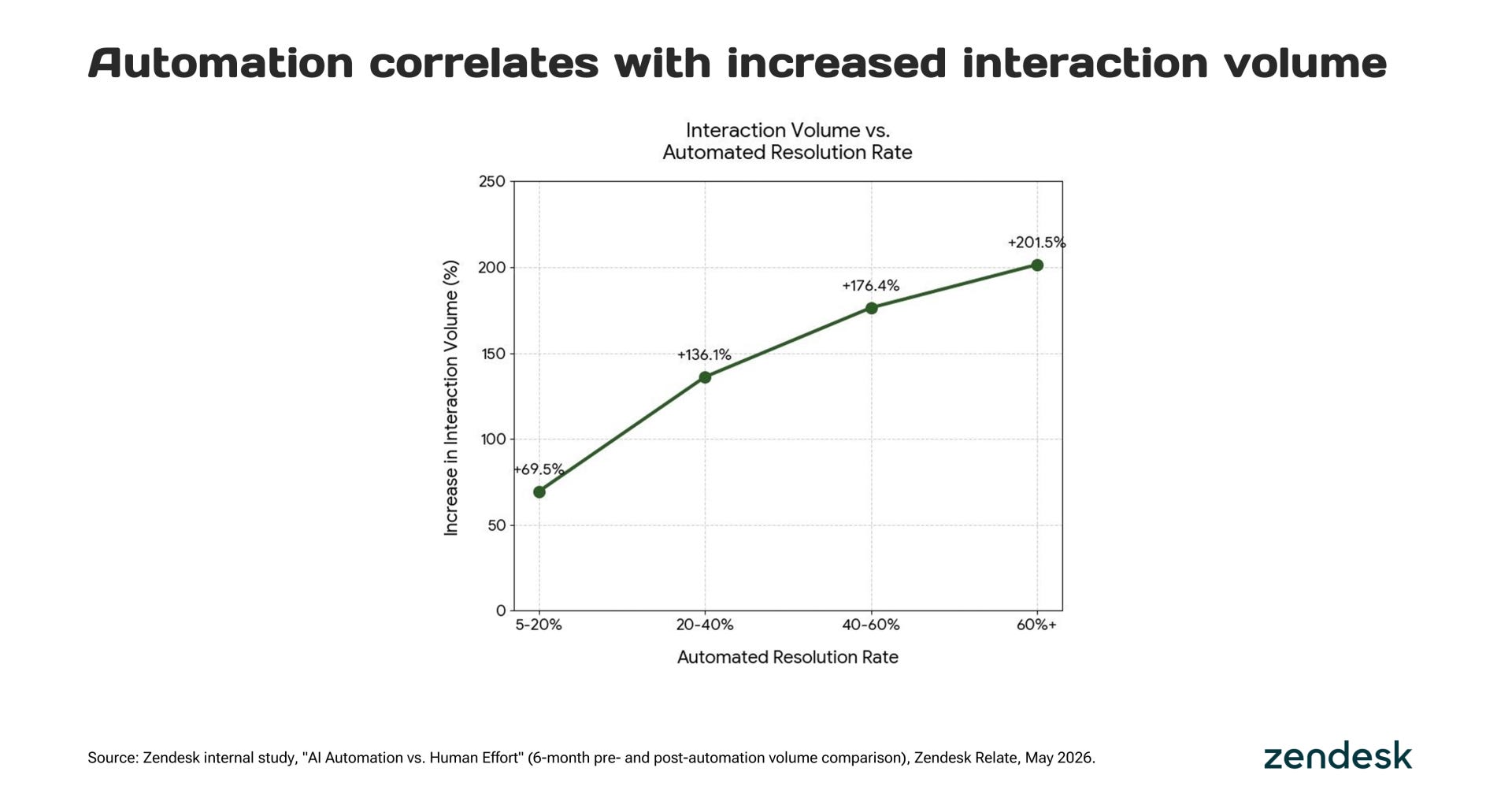
In its AI Automation vs. Human Effort internal study, Zendesk found that automation was actually driving a significant increase in interaction volumes, with larger increases occurring at higher levels of automation. The study reported up to a 200% increase in volume at a 60% automation rate, suggesting that Jevons Paradox is at play in customer service.
Second, the occupational definitions we rely on are increasingly misaligned with how customer-facing work is structured:
The contact center represents a relatively recent addition to customer service. Its structure reflects a traditional pattern of decomposing customer service work across the enterprise, mirroring Taylorism in early 20th-century manufacturing.
It is a carved-out “front-end layer” for customer service, optimized for rapid responses through large pools of agents handling high-frequency inquiries, while other tasks are offloaded to specialized departments. Over time, these functions have become even more specialized, creating fragmented customer service experiences, longer resolution times, and friction across organizational boundaries.
AI is not only becoming the “front door” to service, delivering instant responses, it is also assisting customer-facing associates with specialized tasks, enabling a reaggregation of jobs. Instead of funneling customer communications through the contact center to dispatch the work, a larger pool of the workforce will interact directly with customers.
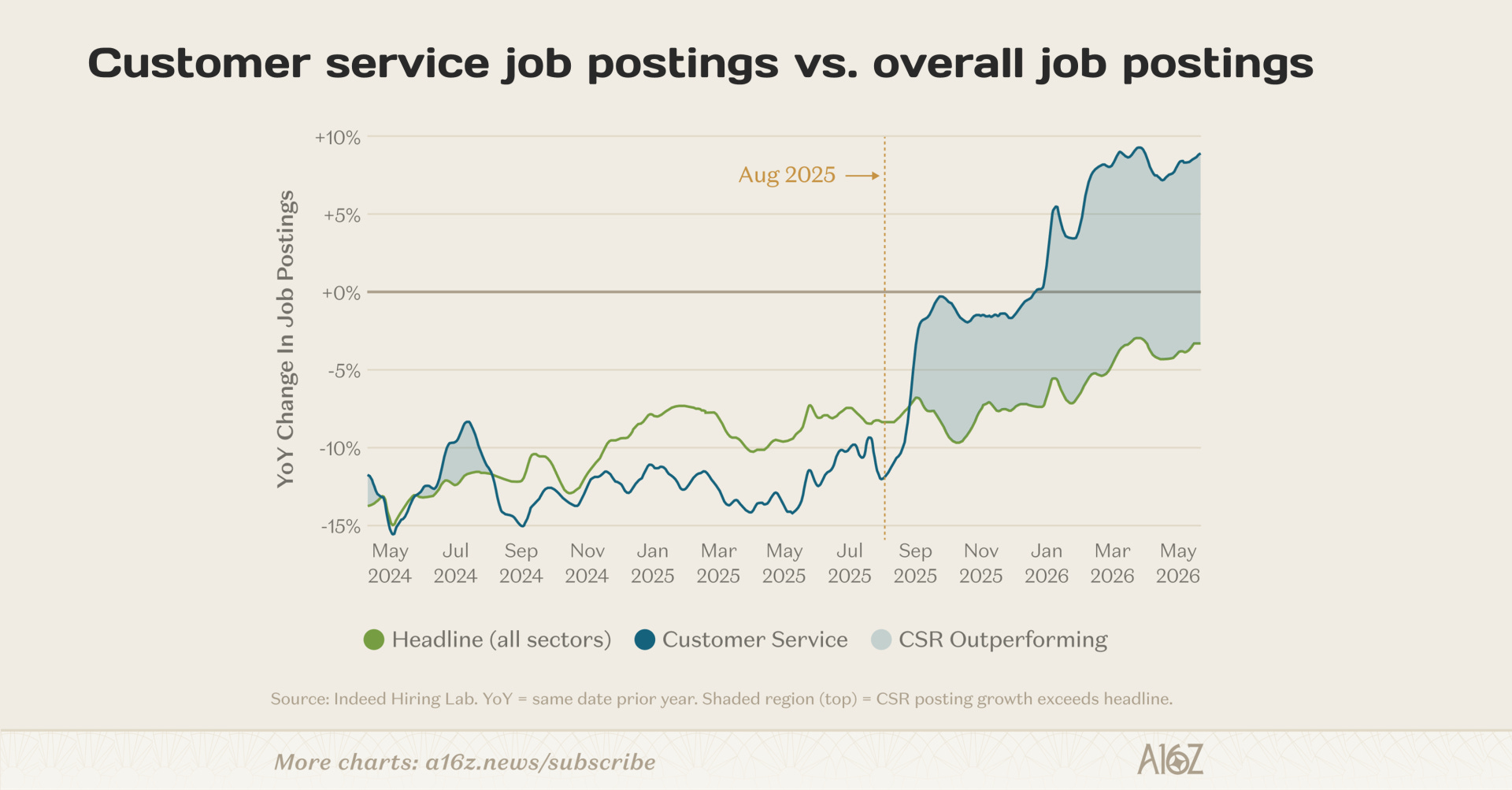
Taken together, these dynamics suggest the contact center, as a distinct organizational construct, is likely to dissolve into a broader customer-facing operating model.
Rather than framing this shift as AI-driven job elimination, the focus should be on how customer engagement work is redistributed between AI and humans across the enterprise, and how that redistribution reshapes customer-facing roles.
A corollary of this transition is that many entry-level customer service roles that have traditionally served as an entry point into the workforce will disappear, and organizations will need to rethink pathways for employees entering the workforce.